Essays
About keeping promises you make to yourself
Draft
Well it really is essential. Well why? Hmm i’m not sure. It is what makes you believe in yourself. Literally. Imagine that you talk to your friend and you agree to meet for a beer the following day. When the day comes you stand at the agreed spot and he does not show up. You get a bit annoyed but carry on with your day. Later in the week you again run into them at university and agree to meet for a beer the following day. The next day you again stand at the agreed spot and he does not show up. Now next time you see him at campus and he asks you if you want to go for a beer the following day, you reply that you would like to but you don’t believe that he will show up. If he told you he would be there the next day you would not believe him.
Why is it so bad to not believe him? Well it is sad really. Because you wonder why he would lie to you. And why he would choose to make the agreement if he was not going to show up. Maybe, when he made the commitment, he thought that he, the following day, would have energy to do it. But then when the day came he did not. You can respect that, but it shows you that your friend does not know himself very well, and that he does not prioritise you or prioritise keeping his word over relaxing or doing something else. So after not keeping his word multiple times, you know that his word is not worth anything. You can still spend time together at campus but each time your friend tells you he will do something you say ‘right’ and do not believe a word.
The result is that you learn that if you make a commitment with your friend, then all it will lead to is disappointment and a feeling of being let down. This feeling hurts. And after experiencing it enough times you might stop making commitments with your friend because you don’t want to feel that feeling.
It is the exact same thing with your own promises to yourself. When you, over and over, make promises to your self and don’t keep it. You learn that your word is not worth much.
Why is that a bad thing? Well because your belief in your word is what makes you feel capable of doing things. For example, if you feel unhealthy and you feel sad because your girlfriend just left you because you don’t take care of your body. You might feel a desire to change that and get in shape. But that desire will amount to nothing. Because in order to get in shape you need to work out for an extended period. Meaning that you go work out today. But also next week, the week after and the week after that. In order to believe that you can get in shape you therefore need to believe that you can promise yourself that you will work out each week, and keep that promise.
So if you don’t believe that you can keep the promises to yourself, it leads to not believing that you can do the things that you want to do and get the things you desire. Having things that you desire, but knowing that you will not be able to achieve them is a terrible feeling.
Okay. So when you don’t keep promises to yourself, you loose that belief that you can keep your promises. That makes sense. There are different types of promises. One type of promise is a goal. For example i will get in shape by working out two times a week, Monday and Wednesday for the next four months. So we would be able to say that if you don’t keep the promises to yourself, you stop believing that you can reach the goals you set. And you might be afraid to set goals because you don’t want to end up disappointing yourself again.
Addition
Now there is something more. In the act of breaking your promise to yourself, something happens. Lets say you promised yourself to wake up early because you wanted to go to a fitness class in the morning before work. You went to sleep early and slept eight hours. But as your alarm goes off you look at the time and choose to sleep longer instead of working out. What happens here? Well in the moment you are to choose between getting two more hours of sleep or working out. Why would you choose to sleep longer? Probably because you are a bit tired and it is comfortable. But why did you set the goal of getting in shape to start with? Well you set it because you wanted to become more healthy. Well why did you want to do that? Because you thought that that would make you happier and give you a better life. So you did it because you wanted to improve your life? Well why did you want to improve your life? Does someone like you deserve a better life than the one you have? Well yes. Why? Well because i deserve it. Why do you deserve it? Well because i am good, and i have value and i am important.
Now when you choose to sleep longer instead of working out. You probably tell yourself that it does not matter that you miss one day. Or that you will just work out harder next week. But unconsciously you know that you will not work out harder next week. Because you are not a person who keeps the promises that you make. And you know that missing this first work out day will make it easier to miss the next. You know this because you have seen yourself break your own promises year after year and you know how this will go. So when you choose not to wake up and work out. Deep down you know that you are choosing not to get in shape. Now i thought that you wanted to improve your life because you deserve a better life. But now you choose not to get in shape anyway, and thereby you choose not to improve your life anyway. What changed? You knew that you would be tired and that the bed would be comfortable in the morning when you made the promise. What has changed that now makes you choose not to improve your life? Do you still have worth? Are you still important? Well yes. Do you still deserve to get a better life than the one you have? Well yes. So you deserve a better life. Why then do you now want to improve your life? Well because i would rather sleep. So you don’t find it worth it to experience the uncomfort of getting out of bed, in order to improve your life and get in shape? Well no. So you value not being uncomfortable right now higher than improving your life. Yes. Okay. Do you still want to improve your life? Yes. Do you still want to improve it if it means that you have to put in the effort? Well no not at this moment. The fact that i don’t wish to get up shows that quite clear.
About always saying whats true
Journal
Well i don’t really know what to start with. It seems kinda obvious. Why is it important for you to say whats true? if you had to give three reasons what would they be? Well it makes you happy about yourself. That could be the first one. It makes everything you say resonate with other people, and they will usually respect you more. That is quite an important point because that was first made saying the truth important to me. This point could be good to start with. What about a third reason? If i had to say something it could be that it makes you move toward in life and not stop yourself. Lets start with the second point.
How telling the truth became important to me.
Well there was a time when i was not as social as i am now. And when i say that i mean that i did not understand how the social world really worked which ended up making it difficult to say the right thing when i was talking to people and have people like me. So it was difficult for me to be liked by other people. At this point i would often have conversations with someone where i got so conscious about what i needed to say or respond with that would make them like me the most. All interactions started to be difficult because i didnt know what i needed to say in order to make someone like me the most and i often ended up thinking that saying something would make them like me and then after i said it i realised that it was not the case and it instead had the opposite effect. I would often say things which was not completely true or alter the reality i told people i had because i thought that they would like me more if i told them about that reality instead of the reality that i actually had. But it was always my experience that the interactions where i did were the worst interactions i would have and would be where i connected the least with people and where i felt that in the end they might like me even less than before. I realised that this was the case, and that was one of the things that made me start trying to not lie when talking to someone. Because when i lied about myself then i would always end up making people like me less. And i didnt want that to happen.
About the art of agreeability
Essay
About anger
Lets start by trying to define anger. I think that all anger comes from hurt. Without hurt there cannot be anger. This is the foundation that we would build our thoughts about anger on.
How can we be hurt? If we find the different ways in which we can become hurt we find the ways that we can become angry.
Fear. Imagine being a parent to a kid who is running around having fun in the city. The kid does not pay attention to the road and suddenly it almost runs out in front of a car that is speeding by. The fear that you experience in that moment might turn into anger towards the kid, the car or yourself.
Physical pain. Someone kicks your shin.
Someone taking something you perceive as yours. If someone tries takes your laptop while you are in the bathroom.
Loosing something that you care about. I was thinking that in the case with your laptop it might also be all the things that you have on your laptop that it hurts to loose. All your notes, all your files, you need it in order to study successfully. It is valuable to you in so many ways.
Someone not following the norms that you follow. If you care deeply about the environment and the fact that you don’t throw trash on the ground. Then seeing someone throw a plastic bottle on the street in front of you could make you angry. Or if you are driving and someone cuts you off then you might become angry because they don’t drive in the way that you expect yourself to drive. In this case it might also be because you feel that they drive in a way that is dangerous and that it could potentially hurt someone.
Someone hurting an innocent animal. Why does this hurt me so much?
I might look into the above a bit further. It is not completely clear so far what types of hurt there is. David Whyte said that “Anger is the deepest form of compassion, for another, for the world, for the self, for a life, for the body, for a family, and for all our ideals, all vulnerable and all, possibly about to be hurt.”. Here states that anger is a type of compassion. A compassion that shows up when we perceive that one of the following is hurt,
Another person | The world | The self | A life | The body | A family | Our ideals |
He says that anger arises when we perceive one of these to be vulnerable and about to be hurt.
So the idea is that it is not logical to blame anything other than nature and the universe for the harm or threat of harm to something you value. It is not possible to conclude what it is that has caused situation to happen the way it has.
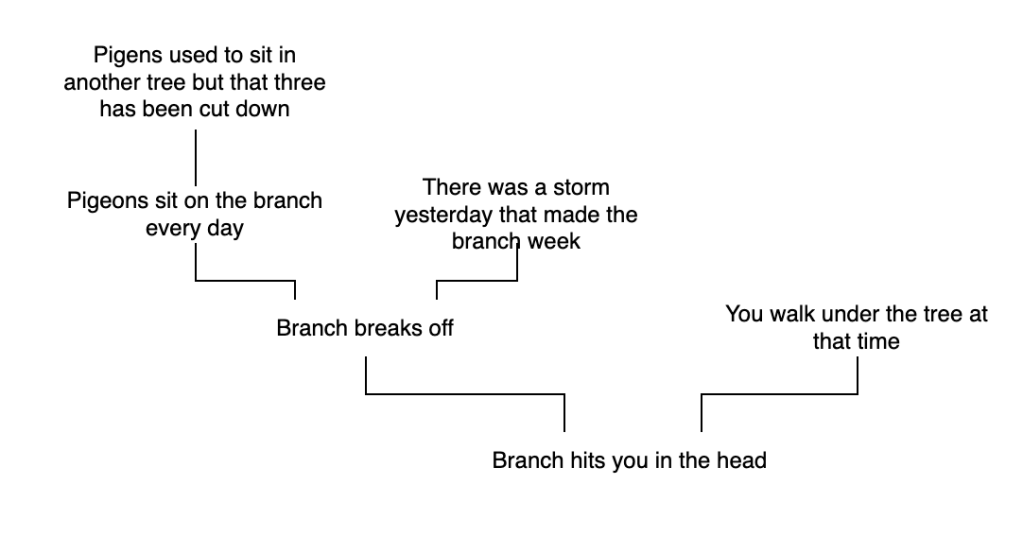
An example is that you walk in a park and suddenly feel a hard bonk on your head. It hurts like hell. You grab your head and realise that the back of your head is bleeding a little. You look around and find that a branch has fallen of the tree just as you walked under it. You cant really get angry at the tree for causing you harm. It cant be said that it is the trees fault that the branch broke of. There was a storm yesterday that almost made the branch break of and made it week, maybe a bird landed on the branch and made it break. Still it hurts and you feel incredibly unlucky and think “ahhhhh, why did this happen to me!”. The anger that you feel here is caused by the injustice of the situation and the anger that this creates is directed towards nature and the universe. This is the anger that appears when you feel truly unlucky.
Lets imagine another scenario. You’re walking in the park, and suddenly feel a hard bonk on your head. It hurts like hell. You grab your head and realise that the back of your head is bleeding a little. You look around and find that someone was trying to throw a branch to a dog and ended up hitting you in the back of your head. As soon as you realise that they hit you with the stick and made your head start bleeding you get angry. It hurts and because you see the person as the reason for the unjust pain you direct your anger at them. You think “What are you doing, don’t throw sticks to your dog if you cant throw properly. Open your eyes and look around you idiot”.
But the situation can be analysed in the same way. Maybe their parents never thought them how to throw, and they were always just talking in the breaks in school and never learned how to throw properly. Then you might say, okay its fair enough that they don’t know how to throw a stick, but if they don’t know how to throw then they should’t throw sticks in parks where there are other people. True, but maybe they are walking their friends dog for the first time. And they have always seen people throw sticks so easily. Maybe its their first time trowing a stick and they thought that it was much easier than it is. They didn’t know how difficult it was. It can’t be their fault that they didn’t know that. Is it then their parents fault that you got hit because they didn’t teach their kid how to throw a stick? But there is reasons for that too. Or maybe the person was distracted and didn’t see you because their dad just died this morning and they are overwhelmed with grief and couldn’t think or see clearly.
The point is that there can always be reasons that “justifies” the action. From that it can be argued that there never is one place where the blame can be placed for something. Anger therefore would not be able to rightfully be directed towards it.
But if the hurt happens because someone
About life being a dessert with different oasis of passion
Essay
About keeping your accomplishments to yourself
Essay
About addiction showing you what is bad for you
Essay
About how living another persons life
Essay
About not saying what you will do before its done
Essay
About making yourself excited about small things
Essay
About checking that you have the right intentions
I was reading the into psyk book and i noticed myself thinking that the words and the language was overly complicated. I thought that if i were to make a book i would simplify it as much as possible and make it easy for anyone to understand. Then i noticed thinking that maybe the writer of the book did not only have the intention of teaching the knowledge in the best way, but also had the intent
About happiness not being a feeling but being the lack of wanting something
Journal
I was just reading about psychoanalysis. Reading my past notes about the unconscious. I was reading the following,
Jeg’et påvirkes af det rationelles sekundære processer, såvel som det påvirkes af det underbevidstes primære processer. Det’et er det underbevidste som som leverer en række følelser. Følelserne, medbringer motivation (energi og retning).
Then i thought,
well if all emotions have energy and a direction. What direction would happiness then have? It does not really seem like it has a direction.
Then i thought,
maybe happiness is not an emotion then
Then i thought about this,
Like if i wanted a dime when i was five years old, and it would make me happy, if i still had a dime then i should still be happy. But it doesn’t work that way. Does it? So we think that getting what i want makes us happy. When we get what we want we experience this blissful moment, when we got what we want, we don’t want anything else. And the joy that we experience, the release that we experience, the happiness, is not because we got what we wanted, but because we’re no longer wanting. We for a moment experience the great happiness of not wanting anything.
– Adyashanti
Maybe when we experience happiness it is the experience that for that certain amount of time, we do not want anything else than what we have.
This could be when you sit with a coffee in the mortning in your favorite chair, and for that brief time, you have forgotten all the other wants that you normally have. You have forgotten that you are trying impress your boss so you can get a raise. Or that you want to read the articles for the course you have so that you do well on that course.
Maybe its the same if your best friend really wanted to study something, they were super nervous about wether they would get in, you sit together waiting for them to get their answer. They get in. You are both incredibly happy in that moment, hold each other and jump up and down. The reason you experience that is because for that brief moment you have everything you want.
Maybe then, one way to be a bit more happy, is to think more often that, right now, doing what im doing, being where i am, i want nothing else. There is nothing that i would ask for right now.
Thats difficult. I was about to extend the previous line with the following,
Maybe then, one way to be a bit more happy, is to think more often that, right now, doing what im doing, being where i am, i want nothing else. There is nothing that i would ask for right now. Not that i had read and understood all my articles, not that i had more money to travel. If someone asked me if i wanted this right now i would say no.
But this would seem to ruin the moment that i imagined. Because it would bring focus to it. And bring the want back. But that is funny. Because is it then that happiness comes when you don’t want more money to travel. Or is it that happiness comes when you have forgotten that you want money to travel. Maybe the want does not need to disappear. Maybe it just need to be forgotten for a moment. Or maybe when it is forgotten it is actually gone. That would be interesting to think more about.
About thinking about a world where you don’t exist anymore
Journal
Yesterday i was talking to Maria about weather or not we would want to leave messages to people when we die. That was a weird thought for me. Because it was making me make a decision of wether i wanted to have an influence on peoples lives and the world after i died or not. Both options clearly show that the world will continue and the life of everyone will continue as they always have. And i was thinking that i would die, and the following weeks after i would watch my friends and family read the messages and see what impact it had on them. Knowing that no matter what would happen after that i could not influence anything. And essentially my existence as the person watching the lives of my friends and family would not really matter at all. I think that thought is quite powerful. Because it forces you to momentarily believe that you are not the center of the universe, and that the world would pretty much be the same without you.
I was reading the notes about psychoanalysis and the grandiose self, which said that,
Det grandiose selv er den del af dig so ser dig selv som det almægtige centrum for verden. Det grandiose selv er altid opmærksomhedssøgende og kræver bekræftigelse fra omverden.
I then thought, what would happen to the grandiose self if you kept imagining that scenario and thereby kept reminding yourself that the world would be the same without you.
About respect being something you can use to reduce your jealousy based judgement
Journal
About living in the present and how that is what happens when you are at parties or festivals
Journal
About impulses showing up as a badge which can be accepted or ignored
Essay
About recognition
what does it mean to feel recognition. I was reading about the reasons people feel happy when they experience being part of a crowd. One of the reasons is recognition. There are different ways of being recognised. You can be recognised as a human being. You can be recognised as a group member. You can be recognised as a threat from an out-group member. But all recognition can be a good thing. Why is that? Is that because one of the greatest pains is to be invisible in the eye of others? Is it because all recognition tells you that someone has seen and noticed you. How does belonging relate to recognition? Is one requirement for belonging that people around you recognise you when you are there and realise when you are not?
About the difference between agreeability and kindness
Essay
Feelings
Anger Journal
Lets start by trying to define anger. I think that all anger comes from hurt. Without hurt there cannot be anger. This is the foundation that we would build our thoughts about anger on.
HOW CAN WE BE HURT?
If we find the different ways in which we can become hurt we find the ways that we can become angry.
Lets start by trying to think of the different ways in which we can become hurt.
Fear. Imagine being a parent to a kid who is running around having fun in the city. The kid does not pay attention to the road and suddenly it almost runs out in front of a car that is speeding by. The fear that you experience in that moment might turn into anger towards the kid, the car or yourself.
Okay so fear is acutally very connected to anger. Is it because fear is a sort of hurt or pain? That is one thing we will have to return to.
Fright. I was just thinking that the above example might also be considered as fright. If you for example become frightened by someone jumping out in front of you with a scary costume this can turn into anger. Is this a form of fear? What is the difference between fear and fright?
Physical pain. Someone kicks your shin.
Someone taking something you perceive as yours. If someone tries takes your laptop while you are in the bathroom. In the beginning i thought that this was connected to someone not following norms, but now i see that even in a sort of primal world where it is normal to steal all the time, you would still get angry when someone does it or tries to do it. This is connected to loss and the fear of loss. Which i think might be one of the things that are the foundation for most anger. Now it is interesting that there is two different scenarios, one is where you figure out that your laptop has been stolen and it is gone. The other is where you find someone trying to steal it. The first scenario you clearly experience a loss, in the second you experience the perception that you might soon experience a loss. So the second is probably fear of losing it. But is there a difference between the anger that appears from figuring out that someone has stolen the computer and the anger that comes from someone trying to steal it. I just realised that it might not actually be fear in the second case. Or well i could say that i am scared that i will lose it if i dont stop them. But then in some sense it is directed towards me. And if i fail i would be angry at myself. Maybe it is fright, or being scared. Or actually threat, they are threatening me by trying to steal my laptop. Or maybe it is hurt, that they are actually trying to hurt me by taking it. It could actually be the last one. That i perceive that someone is actively trying to hurt me right now. I think this is it. So in one case you experience that someone has taken your computer and in that way hurt you by making you lose something you valued. In the other case you experience someone trying to hurt you by making you loose what you value. It all seems a little bit blurry right now. But i think there is an important point to be found somewhere in it. That is it. Danger, being in danger of being hurt. There is a difference between being hurt or being in danger of being hurt.
Loosing something that you care about. I was thinking that in the case with your laptop it might also be all the things that you have on your laptop that it hurts to loose. All your notes, all your files, you need it in order to study successfully. It is valuable to you in so many ways. yeah so this is again connected to losing something which has value to you.
Someone not following the norms that you follow. If you care deeply about the environment and the fact that you don’t throw trash on the ground. Then seeing someone throw a plastic bottle on the street in front of you could make you angry. Or if you are driving and someone cuts you off then you might become angry because they don’t drive in the way that you expect yourself to drive. In this case it might also be because you feel that they drive in a way that is dangerous and that it could potentially hurt someone. So in that case their way of driving frightens you in some sense.
Someone hurting an innocent animal. Why does this hurt me so much? I dont know. I think this might be one of the ways which i am most likely to feel anger. Is this because i in some way become hurt by it? Or is anger just as likely (if not more for some people) to arise from the perception of other people being hurt or being in danger of being hurt.
Okay so to sum this up we have found that anger arises from the perception being hurt, being in danger of being hurt or the perception that other people are being hurt or are in danger of being hurt. Okay great. Now we were actually looking at the ways that you can be hurt. We found that hurt could be experienced physically, im realising that the different scenarios above are not really following the same pattern. But anyway, we found that hurt could be experienced physically. This can be framed as loss of bodily and physical health. Or maybe even danger of death. So that is one way that you can experience hurt. Now what is the other ones? There is the hurt of loss of value. Well this could be that your physical health is value to you. So it would be. Hmm i just realised that hurt might be defined as loss of value. And in order to understand the ways we can be hurt we need to understand what value we can lose. I guess this is actually what im in the middel of doing. Anywho, where were i. Well we found that you could be hurt by loss of physical health. You can also be hurt by loss of material wealth. For example when i lose money or my laptop. I guess we would ask what value the laptop have for me. And i would answer that it is what allows me to study and program and other things. So i guess the loss of the laptop represents loss of the ability to study and to learn about psychology and philosophy and the ability to program projects that i find fun. I guess then if those abilities was taking out of the laptop so it could not do that then actually i would not become as attached to it. Thats quite interesting. I was imagining how i would feel about the laptop if it did not allow me to study, learn psychology and philosophy or program, and to be honest i would not really feel much about it then. It would not really have that much value to me and i would not care much about it. So the computer represents abilities to do things i like. Right so i can be hurt by loss of physical health, and by loss of the ability to do things i like. That is something. I still think that there is more to the last part. Ability to do things i like is sort of vague. But im starting to lose interest a bit. Okay what have we found so far. Well we have found that anger arises from the perception of being hurt, being in danger of being hurt, or the perception that others are hurt or are in danger of being hurt. Then we found that all hurt is loss of value. Which might be a definition. Did we find something else? Yes we found that different types of hurt is, hurt by loss of physical health (which might be perceived as danger of hurt by loss of life), hurt by loss of ability to do what makes you happy (which might be why it is so painful for someone like a football player to get a cronical leg injury), this also ties to another hurt which would be hurt by loss of identity or self-esteem. This last one is a bit broad. But i think so far we are on the right track.
Okay what else is there? I think i might have a discussion about this. Okay that is quite interesting. So i was talking to grok and it pointed out that physical pain makes the body feeling threatened. So when we experience physical pain, we dont just feel a loss of pysical health or being in danger of loss of physical health, but if we imagine the body as a brain of iself, and all it sees is that it registers pain, this would be considered as being an indicator that right now we are in danger of death. In the beginning i thought that maybe all pain is interpreted by the body like this, but then i realised that that is not the case, and that the perception we have in our brain of the pain and how vulnerable we are is a big factor in whether the pain leads to anger. Okay these thoughts are a bit of topic but still interesting. Lets see about the other types of hurt.
Okay so there is the social and relational type of hurt. So things like rejection is very relevant here, or betrayal or disrespect. Im not sure how the two last ones play in yet but rejection seems very essential. I guess it would be useful to have a big sit down looking into rejection and the definiton of this now. But im not gonna do that every time i come across a concept which i have not yet dived deeply into. But rejection connects to our sense of belonging. And it is something that is valuable. Even found to be a true need for human beings (Baumeister & Leary, 1995). So this would probably be one way to be hurt. So is this what we would call hurt by loss of sense of belonging? Im not sure. I think it is. And this is one of the things that happen during rejection. Well i guess that it depends on what kind of rejection. If i sit with a group of good friends, and see someone i find attractive, go over and introduce myself, and she rejects my flirtations, then it might not necessarily mean a loss of a sense of belonging but a loss of a sense of attraction maybe. So we can agree that hurt by loss of a sense of belonging exists but is it the right word to use. Would hurt by loss of relations be better? Because as soon as we start with the ‘sense of’ or ‘perception of’ then we get into all adjectives. Attraction, im trying to find more obvious examples. But its difficult. Maybe the ‘sense of’ is actually right. That would leave us with the types, hurt by loss of relations, hurt by loss of sense of belonging, hurt by loss of sense of attraction. We can start with those so far.
So we have: hurt by loss of life, hurt by loss of physical health, hurt by loss of ability to spend time on what makes you happy (could be boiled down to hurt of ability/capability/opportunity), hurt by loss of relations, hurt by loss of sense of belonging, hurt by loss of sense of attraction
Okay. Now the last one, hurt by loss of sense of attraction, seems to be connected to self-esteem. Here i cant help but think that it would be useful to have a deep insight into what attraction and the sense of being attractive means. Anywho it seems connected to identity and self-esteem. So it might be better to call the type for hurt by loss of self-esteem. And then one of the ways you can loose self-esteem might be by losing sense of attraction.
So we have: Anger arises from the perception of being hurt, being in danger of being hurt, or the perception that others are hurt or are in danger of being hurt. All hurt is loss of value. Different types of hurt are: hurt by loss of life, hurt by loss of physical health, hurt by loss of ability, hurt by loss of relations, hurt by loss of sense of belonging, hurt by loss of self-esteem
Thats pretty good so far. Right so where are we. We have some different kinds of hurt so far. We have six so far:
Life, physical health, ability, belonging, self-esteem.
Lets get some perspective on this by having a talk with grok. Right, it mentioned that i might look into fairness and justice. That loss of fairness or justice is something that might cause anger. It also mentions that one reason why you might be so effected by animals in pain is both because of empathy, and because you see a loss of fairness, but also because you perceive a loss of goodness in the world. Which i think might be true. The fact that when you see something like that you are forced to let go a bit of the image of the world being a good place. And people being good. That is a loss of the goodness of the world. Is this different from fairness? Hmm i feel that it is. In what way? Well in the way that. Hmm i dont know. What does fairness mean? I guess it means something about you get what you deserve. But what then is the difference between fair and just? Hmm. I dont know. If something is fair, it is agreed that that is how it should be. Lets take an example. If i push you then it is fair for you to push me back. In this way fairness seems to be related to balance. What about when someone says, i don’t intend to do as you say, and you say “okay fair enough”. Well then you say that it is fair that you don’t want to do it. But what does this mean. You are saying that if you don’t want to then it is fair not to do it. Hmm. Right. So what is fair here is to not do the things you don’t want to do. Right. And does it mean that this is fair? Well it means that it is in accordance with the way that the universe works. Not that it makes sense. I thought for a sec that it being fair might mean that it makes sense. But i see that this is not really the case. Because if it makes sense, then it is in accordance with reason and logic. Something like that. But if it is fair it is in accordance with balance. So that it is fair to not do what you don’t want to. Then it means that this action is one of the actions which keeps the balance. Now would you then say that it is unfair to do something you dont want to do? Well you would say (in the extend it is not a discipline thing) that it don’t make sense. Not that it is unfair. That is doing something you dont want to do does not cause unbalance? No i dont think so. Okay I think maybe i got an idea about it. So if something is fair, it belongs to the list of actions (because fairness is always related to an action) that does not cause unbalance. I think this is the best definition i have of it so far. Now lets look at that for a sec. So first of all, is fairness always connected to an action? It is fair to do this, it is fair to think this. Thats actions. “I slipped and fell into a lake, its so unfair” well this does not really make sense does it. It would be “it is so unlucky”. “It is unfair that he got more than i did”. Now this depends on wether you think that there was underlying actions behind this distribution. It is unfair that she has so much when i have so little. What does unfair mean here? I think it might mean that the actions underlying the fact that she has so much when i have so little is unfair. Okay i talked to Annabel about it. It seems as a bit clearer now. So this definition has the assumption that fairness is always related to the actions of people. A situation only becomes unfair if the actions that caused this situation is unfair. If no unfair actions have caused the situation then the situation is not unfair. For example if som branch fell of a tree and hit you in the head. Then this would not be unfair but it would be unlucky. I also now realise that fairness is always related to the favouring of one person over another. For example if we imagine that a person sits in the tree and throws the branch down on your head. Then you still would not think ‘this is unfair’, you would think “that is so mean”. But if you were walking with someone and the person in the tree still chose to throw the branch down on your head when they could have chosen to aim for your companion. Then suddenly there is an element of “it so unfair that this always happens to me and not you”. Well i guess there always is the posibility that the person thinks “Why does this always happen to me”. Lets take the example from friends. So they are sitting in the cafe, chandler is smoking and they say he has to put out the cigaret, to which he says “this is so unfair”. In the beginning they say no its not unfair. But then he says that all of them have some faults which is accepted by the rest of the group, so why can his fault not also be accepted. That is one case where unfairness only exists through a comparison to others. So actions that cause you to not having the opportunity to get what others have to opportunity to get. Or in other words, actions that cause you to be treated differently than other people for no reason. That actually is another definition that might be just as good if not better. Okay so so far we have
Two definitions of unfairness:
An action is fair if does not cause unbalance.
An action is fair if it does not cause you to be treated differently than other people for no apparent reason.
How about that definition? Maybe they both make sense. The last definition seems most accurate. Or maybe there is different types of fairness. It seems as if one type of unfair action is an action of treating someone differently than other people for no apparent reason. What is an example of another type of unfair action? Well maybe another type of unfair action would be to. Hmm i guess there might not be any other. I was thinking about the case of not being even, or revenge. That a person A is sitting on a chair and suddenly a person B comes over and pushes them of it. That would be unfair. But if person B comes in and pushes everybody of the chair that they are sitting on then it might change. If you say “why does he do that to us? That was so unfair. And someone answers, well he does that to everybody everywhere. He’s just a dick.”. Then the unfairness dissapears and is replaced by injustice. And now if you look out the window and see some security guards taking him away, and you hear someone whisper, “that was his last warning, now they are going to take him to jail for a year”. The injustice disappears, and you just sit back with a feeling of “well it sucked to be pushed down from my chair”. But i got distracted. I was about to say that if A is sitting on a chair and B comes over and pushes them alone, then it seems unfair because they are being treated different for no reason. But if A and B have history, and A just cheated on B and stole all of B’s things, and B just found out, and B comes over and pushes A down. A might think, well i deserved that, that was fair enough. And this is the case because B treated a differently than other people, but there was an apparent reason. I think this makes sense. So so far we have the best definition of fairness which is,
The definition of fairness is so far that:
An action is fair if it does not cause you to be treated differently than other people for no apparent reason.
Right that makes sense. Okay so this actually rests on the idea that people should be treated equally. So i guess that the loss of fairness could be said to be the loss of equality. Okay,
so we have: Anger arises from the perception of being hurt, being in danger of being hurt, or the perception that others are hurt or are in danger of being hurt. All hurt is loss of value.
You can feel hurt by the loss of: Life, Physical wellbeing, Ability, Belonging/Relations, Self-esteem, Equality, Beliefs
An action can be said to be fair if it does not cause you to be treated differently than other people for no apparent reason.
Fairness is always related to an action. A situation can only be seen as unfair if it is perceived to be caused by unfair actions.
Now i added beliefs. That you can be hurt by loss of beliefs. Or maybe world view is better. Or core beliefs. Or meaning. Loss of meaning must also be one in some sense. Hmm. What are you thinking here. Well i’m thinking that first of all the belief in the goodness of the world. So if you take the case of someone hurting an innocent animal. By seeing this you for one might experience hurt by the perception of the animals loss of physical wellbeing (misery), but you might also experience hurt by the loss of your belief in the world being a good place. Because seeing this is proof that the world is not as good a you think it is. And that might be something which would hurt me a lot. And if someone says to you “Well the world really is a terrible place”. Then that hurt is in some sense taken away, and turned into sadness, and now you only experience the hurt from empathy. But what is it this is? This case could be called beliefs. But its not all beliefs. Some elementary practical beliefs does not cause any harm to lose. And i guess the discomfort that this loss causes is also dependent on the way that your brain works. But in essence i would say we could call it core beliefs. But it could be argued that the reason that it hurts to loose these core beliefs is because some of your identity is attached to it. And then it would be the loss of identity that hurt. And then the loss of core beliefs would just be one way of loosing identity. I think this might be true. But relations is also connected to identity. And ability Then we could place all these under identity perhaps. As loss of identity (ability, relations, core beliefs). Yes lets do that so far.
So we have: that you can feel hurt by the loss of Life (physical wellbeing), Belonging, Self-esteem, Equality, Identity (Ability, Relations, Core beliefs)
Thats pretty good so far. Lets see what Groks thoughts are about this. Okay good, now we talked a bit about autonomy and control. That autonomy is the degree to which you feel that it is yourself that chooses your behaviour and decisions. And control is the degree to which you perceive your actions to actually have an influence on the outcome. Now i think that control is the most essential one. And autonomy is weather you yourself is in control of your decisions and actions. It did agree. And mentioned that autonomy would be a good subgroup of control which is self-directing (influence you have on your own actions, thoughts, feelings and decisions) and then the other type would be outcome-directing. Very good. I think that makes sense.
So we have: that you can feel hurt by the loss of Life (physical wellbeing), Belonging, Self-esteem, Equality, Identity (Ability, Relations, Core beliefs), Control (Of self, Of outcome)
Okay what now? Well i don’t really see more things that you can loose. Maybe a material element. So belongings. Loosing the things that you perceive belong to you. I guess you cant really loose belonging, you can loose your sense of belonging. I might change it so that it is relations instead of belonging. And then i can add belongings. There could also be safety. But i already but relations under identity. Hmm im not sure. A part of me wants to add belongings. It could also be community. I think that would work to cover. Hmm im not sure. I cold set Belonging (Community, Relations) and then still keep relations in identity. Lets do that
So we have: that you can feel hurt by the loss of Life (physical wellbeing), Belonging (Community, Relations), Self-esteem, Equality, Identity (Ability, Relations, Core beliefs), Control (Self, Outcome)
Now what about source of happiness. For example if someone took the pigeon from my balcony away. I would become sad because it is one of the things that makes me happy. Or if when a parent looses a child they love. They both loose meaning, identity, but especially they now know that this child will no longer be there to bring them happiness. Hmm i’m quite unsure about whether to call it something else than ability. In general i think that there is different sources of positive experiences. There is the sources that belong to you (your senses, abilities (physical, mental)) and then there is the sources that belong to the world. Combining these two sources we create positive experiences. For example watching birds on the balcony which uses sense of sight and understanding (belongs to me) and the birds (belongs to the world). Right so it could be called sources of positive experiences. And then we would have capabilities (internal capabilities, bodily capabilities) and external sources. Okay lets write that up.
So we have: that you can feel hurt by the loss of life (physical health), belonging (community, relations), self-esteem, Equality, Identity (Sources of positive experiences (capabilities (physical, mental, sensory), external sources)), Control (Of self, Of outcome)
Right control i could call autonomy and efficacy. Now for the life (psysical health) i think i will call it bodily wellbeing. That now gives us.
So we have: that you can feel hurt by the loss of Bodily Wellbeing, Belonging (Community, Relations), Self-esteem, Equality, Identity (Sources of positive experiences (Capabilities (Physical, Mental, Sensory), External Sources), Relations, Core beliefs), Control (Autonomy, Efficacy)
Okay now the relationship sub-category in identity is mostly about the fact that when you loose a relationship you also loose a part of yourself. I realised that this is mainly the role that you had in that relationship. After talking to Grok we came up with the fact that this might be changed to Purpose instead. Now Purpose includes key roles. Should it include anything else? I guess it could include goals. But maybe key roles includes the goals you have. So that each goal that matters to you is represented by a role that you see yourself as having? Okay so it makes sense to give the Purpose category two subcategories. It should have one which is key-roles and one which is personal aspirations.
So we have: that you can feel hurt by the loss of Bodily Wellbeing, Belonging (Community, Relations), Self-esteem, Equality (Fairness, Justice) , Identity (Sources of positive experiences (Capabilities (Physical, Mental, Sensory), External sources), Purpose (Key roles, Personal goals), Core beliefs), Control (Autonomy, Efficacy)
Right okay so i will move self-esteem into identity.
So we have: that you can feel hurt by the loss of:
Bodily Wellbeing
Belonging (Community, Relations)
Equality (Fairness, Justice)
Self-Image (private self-image, public (reputation, honour))
Identity (Sources of positive experiences (Capabilities (Physical, Mental, Sensory), External sources), Purpose (Key roles, Personal goals), Core beliefs)
Control (Autonomy, Efficacy)
Right this makes sense so far i think. Lets say that is it. So that is the things which we value which we can loose. Now anger arises when we perceive that someone is to blame for us loosing one of these or is in danger of loosing one of these. Or when we see that it is the case for others.
Okay lets see. I was thinking about a couple of things. First was the definition of danger. I think that danger can be defined as the perceived likelihood of future damage. Now prehaps it is not the percieved likelihood. Because i would think that danger is perceived. With that i just mean that people would say that i perceive we are in danger. And then another say ‘well i perceive that we are not in danger’ In which case it would be a double ‘perceived’ if perceived were a part of the definition of anger. That was a lot of percieved. Anywho, so the definition of danger would be the likelihood of future damage. Or actually more precisely it would be the degree to which you are in a situation where the likelihood of future damage is high. And then safety would be the opposite. That is the degree to which you are in a situation where the likelihood of future damage is low.
So we have: Danger can be defined as the degree to which you are in a situation where the likelihood of future damage is high.
Safety can be defined as the degree to which you are in a situation where the likelihood of future damage is low.
So the degree of danger and safety describes the same thing – the likelihood of future damage. The likelihood of future damage in the situation you are in. I think that it is easier just to define danger as, the likelihood of future damage to you in your situation. Right.
So we have: that danger can be defined as the likelihood of future damage to you in the situation your are in.
Right. Now what about damage. Well i thought that it could be defined as an reduction of your perceived value. Or a reduction in that which you value. Hmm. Im not sure. I think that a reduction in that which you value might be right. Or loss of that which you value. Or maybe just a reduction of your value. Im quite unsure here. I think i will discuss it with grok. Thats actually pretty good. It said that damage is change to a system that reduces its value relative to its prior state. That makes a lot of sense here. So damage to me is a change in that which i find important that reduces its value relative to its prior state. So damage is change. That we can agree on. It is a change to something which reduces its value relative to its prior state. Right so damage to something, is a change to that something which reduces its value relative to its prior state. So damage to me is damage to any of the things that has value to me. And damage to any of the things that has value is change to that thing which reduces its value relative to its prior state.
so we have:
– damage to something is a change to that thing which reduces its value relative to its prior state.
– And damage to me is damage to any of the things that has value to me.
– And damage to any of the things that has value to me is a change to that thing which reduces its value relative to its prior state.
Okay great. I managed to define both danger and damage. So as damage is a part of the definition of danger.
We have that danger to you is the likelihood of a change to any of the things that has value to you which reduces that things value to you relative to its prior state
Okay thats good. So in that way anger is a response to damage or the perception of you or someone empathise with being in a situation where the likelihood of future damage is high. But only if this damage can be blamed on something and if this damage is perceived as unfair. That is the best definition of anger i have so far. Lets summarise all this.
SUMMARY
– danger to someone can be defined as the likelihood of future damage to that one in the situation they are in.
– damage to someone can be defined as damage to any of the things that has value to them
– damage to something is a change to that thing which reduces its value relative to its prior state.
The five categories of value
1) Bodily Wellbeing
2) Belonging
Community
Relations
Reputation/Status
3) Identity
Sources of positive experiences (Capabilities (Physical, Mental, Sensory), Attributes, External sources)
Purpose (Key roles, Personal goals)
Core beliefs
4) Control
Autonomy
Efficacy
Anger is a response to damage to you or someone you care about or the perception of you or someone you care about with being in a situation where the likelihood of future damage is high. But only if this damage can be blamed on something and if this damage is perceived as unfair. That is the best definition of anger i have so far. Lets summarise all this.
Okay very good. Now what i have found only explains in what situations anger occur. And the above summary does not really dive into deeply into the fairness element of anger or the blame part of anger. These are two scenarios of when damage does not lead to anger. Which both are very interesting. Okay this is great. So what i need to dive into if we should make a list is,
– The response of anger. When anger occurs what exactly is it that happens? What different types of anger is there? What is the difference?
– The perception of fairness of the damage
– The perception of blame for the damage
That is great. I could perhaps use a break.
Okay. What now? Well i’m not sure. I guess the next step is to explain the fairness part in a clear manner. So one of the requirements for anger to occur after damage is that the damage has to be unfair. This actually ties together with the blame. Because it is the fairness of your damage to me that prevent me from blaming you. So in that way. I just realised that when control is taken from you and there is no-one to blame. That might be the feeling of frustration. That would make frustration different than anger. Sweet. Okay anyway. Well that is good to know. I think i will brush my teeth. There is also the element that in order for one of these to be damaged or to feel in danger of damage. They have to be perceived as fragile. I dont know how to formulate that. The example with the elderly lady on the bus is good. That she reacts with anger when someone bumps into her because she in a way that other people might not, because she experiences her body as more likely to take damage than a young person might. Right so vulnerable would in that case be something we might have to define. It is the state of something. I was thinking that it could be how likely something is of damage. But that sounds like our definition of danger. But danger is always directed towards the near future. Vulnerability is the current stability of something. Something can be very vulnerable but not in danger. But the more vulnerable something is the more quickly it is perceived to be in danger i think. Right. That makes sense. So two similar things might be compared, one is very vulnerable one not so much. Lets say its two people, where one has a strong self-esteem and the other does not. Now we put both people in the same situation where they are in a social setting and someone makes fun of them. One might experience the joke as damage and the other one might not. So vulnerability determines how quickly you perceive something as damage. It does kinda make sense. If we imagine a perceived danger ‘meter’ which is low when you are safe and high when you are in a scary situation. Then vulnerability is the degree to which this accelerates? It determines how much you would perceive a situation as dangerous. So something that was vulnerable would have the meter increase by 20 while something which is not very vulnerable would only have it increase by 5. Its crazy how good grok is at this. It says that we are on the right track here. Vulnerability is different from danger as danger is immediate risk. Whereas vulnerability is the degree to which something which has value has high susceptibility to damage – meaning that it takes less change to create a notable reduction in value. This makes a lot of sense to me. Especially if we look at the definition of damage from before. Which were that damage to something is a change to that thing which reduces its value relative to its prior state. Now an interesting point is that for something to be able to take damage it has to have value. Now vulnerability is the relation between the change and the value reduction. So lets say that someone has 2 things they are proud of about themselves. They are their looks, their ability to play tennis. This is in some sense what makes up their self esteem. Now if a change was made and someone for a moment made them feel like they were not good looking (“ew that pimple makes you look disgusting”) then suddenly their self-esteem would have been reduced to half of before. Thats a very big change in value relative to its prior state. Now if someone had 10 things they were very proud of about themselves, their looks being one of them. But also how good a friend they are, how skilled they are at the piano, how funny they are and so on. Then if someone gave them the same comment and made them feel like they were not good looking, then the change in value relative to its prior state would not be that large. (from 10 to 9 things they like about themselves). You could also take another good example which might be might economy. If i have 100 000 kr in my bank and i get a metro fine of 500 kr. Then that does not constitute a big change relative to my financial situations prior state. But if i only have 750 kr in my bank then it constitues a very big change relative to its prior state. So in that sense actually vulnerability shows how much value you have in your account. That is the more something is vulnerable the less value you are the less you have. Well im not completely sure about that. Because something can be very valuable but very vulnerable at the same time. Okay that was pretty solid. Grok said that a good way to sum it up is how little change it takes to cause big value reduction. Right.
So if damage to something is a change to that thing which causes a reduction of its value relative to its prior state
Then the vulnerability of something is how little change it takes to cause big value reduction.
This makes sense. And it also makes sense that even though i only have a little money in my account, that money still has incredible high value to me. So it is not that my money is less valuable to me. Right. Whats next. Well that would be to put vulnerability together with anger. How is that done. Well the more vulnerable something you value is to something. The more extreme the change of value will be to a change to this thing. Which means the the more extreme your reaction of anger will be. So vulnerability does not only determine weather you experience anger but the degree to which you experience it. So the degree to which you experience anger is determined by the amount of damage, which depends on the vulnerability of that which was attacked. Yeah it makes sense that how much harm you perceive you take depends on how vulnerable you are and the the concrete change that you perceive that the damage will induce. This is actually interesting. Both because that is a interesting point and because now we have brought harm into the picture. Now i think that it is possible that the difference between harm and damage is the key to this. So damage is sort of objective. It is a measure of change that reduces value. So you can say that a fine might cause a damage of 750 kr. But the amount of harm that this does depends on your financial situation. So you could say that well it did some damage because it caused our business to lose 10 000 kr. But it did not really harm us because we are very very rich. So the thing that i keep feeling off about with damage is that it on the same time defines the change which is fairly objective and the loss of relative value which is kinda subjective. Now harm on the other hand is always the result of damage (a change in the negative direction). And the degree of harm depends on your vulnerability and the concrete negative change of the damage. Yeah i think that might be right. Because you can damage a car. But you cannot harm a car. Harm can only be done to objects which have the ability to perceive themselves loosing value. Yeah so grok mentioned the following. Which i find quite to the point.
Damage is a change to something valuable that reduces its integrity, function, or value relative to its prior state. It’s descriptive and can apply to anything—body, object, relationship, belief, system. The focus is on the thing itself: it is now less whole, less capable, or less valuable than before. Damage doesn’t require sentience or suffering; a cracked phone screen is damage even if no one feels bad about it.
Harm is the negative impact or setback to the well-being or interests of a sentient being resulting from damage (or threat of it). It always involves a experiencer who can suffer—pain, distress, diminished flourishing. So harm always involves an experiencer who can suffer.
Okay so person A can reject person B. Now this actions might cause damage to person B because they now feel less attractive or capable. But this only leads to harming person B when person B actually finds it important to be these things. Person A could also destroy windshield of a car. This would cause damage to the car because it now is less attractive as a car (according to how a functioning car is conceptualised). But it does not cause any harm to it because the car does not find it important to be a fully functioning car. So harm is the perceived subjective reduction in total value from the perspective of that which is damaged. Whereas damage is the descriptive negative change that has occurred. I think that might be the best definition so far.
Damage is the descriptive negative change that has occurred to something valuable.
Harm is the perceived subjective reduction in total value from the perspective of that which is damaged.
I was imagining if there was something that could not really be damaged. To start with i imagined a square meter of dirt with grass on it. Then i imagined someone with a pickaxe hammering into it and destroying its integrity and the grass on it. That i would see as damage. Then i thought well that must mean that i attach value to it. And i think i do. Then i thought. What about a large pile of dirt that has been dumped on the ground. If someone hammered a pickaxe into it it would not make a difference to it. But then i thought well what if someone poured an liquid acid over it which dissolved the dirt. Then i would say that it was damaged. And that made me realise that we say that something is damaged when it in some sense sizes to be what we have defined it to be. So once the dirt is dissolved into the acid and is liquid i would not call it dirt anymore. So when it have to redefine what something is because it no longer lives up to the description of it. Thats quite interesting. The following is how grok summarised the point when i showed it to it.
Grass plot hammered → it stops being a proper “lawn,” so damaged. Pile of dirt dissolved → stops being “dirt pile,” damaged. We damage something when we force a redefinition because it can’t hold its prior identity/integrity.
We damage something when we force a redefinition because it can’t hold its prior identity/integrity. Thats pretty cool. However grok mentions that as we see in the example. Damage is not purely objective. Because it is relative to a conceptual standard of what something needs to live up to in order to have the most value.
So,
Damage is the descriptive negative change to an entity that is valued in a particular way.
A negative change occurs to an entity when it changes in a way that brings it further from the concept of the ideal entity. (For example if our concept of the ideal includes it having a functioning windshield, then destroying the windshield would bring the car further from the concept of an ideal car)
Harm is the subjective understanding of loss in value relative to total value. (how much of your total valued “portfolio” feels lost or diminished.)
So if something happened to me, you could have an opinion of weather i was damaged or not. Say i say i was not damaged and you say i was. But you could not determine weather i was harmed.
Right. Damage is a change to an entity that is valued in a particular way, resulting in a state that deviates from its valued, prior, or expected characteristics—where the deviation is perceived as a reduction in integrity, function, or worth. Right so harm is the subjective understanding of the proportional loss in value resulting from damage. Hmm actually i like the definition i have. Lets move on. Well we want to integrate vulnerability in some way. Now how much harm can happen on you from a little change is vulnerability.
So,
Damage is the descriptive negative change to an entity that is valued in a particular way.
A negative change occurs to an entity when it changes in a way that brings it further from the concept of the ideal entity. (For example if our concept of the ideal includes it having a functioning windshield, then destroying the windshield would bring the car further from the concept of an ideal car)
Harm is the subjective understanding of loss in value relative to total value. (how much of your total valued “portfolio” feels lost or diminished.)
Now how much harm can happen to an entity from little change is vulnerability.
Right very good. Lets include danger in this.
So,
Damage is the descriptive negative change to an entity that is valued in a particular way.
A negative change occurs to an entity when it changes in a way that brings it further from the concept of the ideal entity. (For example if our concept of the ideal includes it having a functioning windshield, then destroying the windshield would bring the car further from the concept of an ideal car)
Danger to an entity can be defined as the likelihood of future damage to it in the situation it is in.
Damage to a person can be defined as damage to any of the things that has value to them.
Harm is the subjective understanding of loss in value relative to total value. (how much of your total valued “portfolio” feels lost or diminished.)
Now how much harm can happen to an entity from little change is vulnerability.
The five categories of value (Areas of importance)
1) Bodily Wellbeing
2) Belonging
Community
Relations
Reputation/Status
3) Identity
Sources of positive experiences (Capabilities (Physical, Mental, Sensory), Attributes, External sources)
Purpose (Key roles, Personal goals)
Core beliefs
4) Control
Autonomy
Efficacy
5) Equality
Fairness
Justice
Now anger does not happen by the amount of damage but by the amount of harm. So the money example is good. The damage of losing 500 kr might not provoke a lot of anger to a person who has million kr. (what i just realised that anger is in the word danger), because that amount of damage would not not cause much harm (low proportional reduction in value). But the damage of losing 500 kr might provoke a lot of anger to a person who has 750 kr because that amount of damage would cause a lot of harm (high proportional reduction in value).
So anger really depends on harm. But all harm comes from damage. Good that is a key note. Right so based on this what can we say about anger? Well we can say that anger is an emotional reaction which happens when you (another) experience harm or are in danger of being harmed. (Here harm means a proportional reduction of value in one of your areas of importance). Now anger only happens when you perceive that there is someone to blame for this harm and that the harm is unjustified.
Anger is an emotional reaction which happens when you (another) experience harm or are in danger of being harmed. (Here harm means a proportional reduction of value in one of your areas of importance). Now anger only happens when you perceive that there is someone to blame for this harm and that the harm is unjustified.
Anger comes from an experience of harm or danger of harm. But all harm comes from damage.
How quickly you can go from being safe to being harmed severely is defined by your vulnerability. Therefore the degree to which you can go from being in no danger to being in danger of great harm is determined by how vulnerable you are.
Great. So we actually have the final summary of what requirements there are for anger to appear in a situation.
SUMMARY
Damage is the descriptive negative change to an entity that is valued in a particular way.
A negative change occurs to an entity when it changes in a way that brings it further from the concept of the ideal entity. (For example if our concept of the ideal includes it having a functioning windshield, then destroying the windshield would bring the car further from the concept of an ideal car)
Danger to an entity can be defined as the likelihood of future damage to it in the situation it is in.
Damage to a person can be defined as damage to any of the things that has value to them.
Harm is the subjective understanding of loss in value relative to total value. (how much of your total valued “portfolio” feels lost or diminished.)
Now how much harm can happen to an entity from little change is vulnerability.
The five categories of value (Areas of importance)
1) Bodily Wellbeing
2) Belonging
Community
Relations
Reputation/Status
3) Identity
Sources of positive experiences (Capabilities (Physical, Mental, Sensory), Attributes, External sources)
Purpose (Key roles, Personal goals)
Core beliefs
4) Control
Autonomy
Efficacy
5) Equality
Fairness
Justice
Anger is an emotional reaction to harm or the danger of being harmed. (Here harm means a proportional reduction of value in one of your areas of importance). Now anger only happens when you perceive that there is someone to blame for this harm and that the harm is unjustified.
Anger towards another is an emotional reaction to harm or the danger of being harmed, when this harm is can be blamed on someone and is undeserved.
Anger comes from an experience of harm or danger of harm. But all harm comes from damage.
How quickly you can go from being safe to being harmed severely is defined by your vulnerability. Therefore the degree to which you can go from being in no danger to being in danger of great harm is determined by how vulnerable you are.
Further questions to answer
– How does the mechanism of blame work? How does this mechanism relate to fairness? (if there is no-one to blame the harm cannot be unfair)
Anger Journal 2
I might look into the above a bit further. It is not completely clear so far what types of hurt there is. David Whyte said that “Anger is the deepest form of compassion, for another, for the world, for the self, for a life, for the body, for a family, and for all our ideals, all vulnerable and all, possibly about to be hurt.”. He states that anger is a type of compassion. A compassion that shows up when we perceive that one of the following is hurt,
Another person | The world | The self | A life | The body | A family | Our ideals |
He says that anger arises when we perceive one of these to be vulnerable and about to be hurt.
So the idea is that it is not logical to blame anything other than nature and the universe for the harm or threat of harm to something you value. It is not possible to conclude what it is that has caused situation to happen the way it has.
An example is that you walk in a park and suddenly feel a hard bonk on your head. It hurts like hell. You grab your head and realise that the back of your head is bleeding a little. You look around and find that a branch has fallen of the tree just as you walked under it. You cant really get angry at the tree for causing you harm. It cant be said that it is the trees fault that the branch broke of. There was a storm yesterday that almost made the branch break of and made it week, maybe a bird landed on the branch and made it break. Still it hurts and you feel incredibly unlucky and think “ahhhhh, why did this happen to me!”. The anger that you feel here is caused by the injustice of the situation and the anger that this creates is directed towards nature and the universe. This is the anger that appears when you feel truly unlucky.
Lets imagine another scenario. You’re walking in the park, and suddenly feel a hard bonk on your head. It hurts like hell. You grab your head and realise that the back of your head is bleeding a little. You look around and find that someone was trying to throw a branch to a dog and ended up hitting you in the back of your head. As soon as you realise that they hit you with the stick and made your head start bleeding you get angry. It hurts and because you see the person as the reason for the unjust pain you direct your anger at them. You think “What are you doing, don’t throw sticks to your dog if you cant throw properly. Open your eyes and look around you idiot”.
But the situation can be analysed in the same way. Maybe their parents never thought them how to throw, and they were always just talking in the breaks in school and never learned how to throw properly. Then you might say, okay its fair enough that they don’t know how to throw a stick, but if they don’t know how to throw then they should’t throw sticks in parks where there are other people. True, but maybe they are walking their friends dog for the first time. And they have always seen people throw sticks so easily. Maybe its their first time trowing a stick and they thought that it was much easier than it is. They didn’t know how difficult it was. It can’t be their fault that they didn’t know that. Is it then their parents fault that you got hit because they didn’t teach their kid how to throw a stick? But there is reasons for that too. Or maybe the person was distracted and didn’t see you because their dad just died this morning and they are overwhelmed with grief and couldn’t think or see clearly.
The point is that there can always be reasons that “justifies” the action. From that it can be argued that there never is one place where the blame can be placed for something. Anger therefore would not be able to rightfully be directed towards it.
Right starting over. So here i would like to define fairness again. Before i made the definition:
An action can be said to be fair if it does not cause you to be treated differently than other people for no apparent reason. Fairness is always related to an action. A situation can only be seen as unfair if it is perceived to be caused by unfair actions.
But it does not necessarily need to be that i think. Well i was earlier talking with grok about fairness depending on weather a rule is broken which causes unbalance. A good example would be that me and you are the only people in the world. We are living in a forest. And you keep hitting me every day. And at some point i say, hey its not fair that you keep doing that. It hurts and i haven’t done anything to hurt you. That would be a rule which is different from equality. In that way one rule of fairness could be that if i don’t hurt you then you don’t hurt me. Another rule could be that you don’t treat people differently for no reason. I think this makes sense. This could actually be called the rules of reason. Or something like that. I guess that is not necessarily the rules of fairness. Not treating one person differently for no reason could be a rule of fairness. Hmm. I should go work out. Later i will look into the next topic of anger which is the emotional reaction.
Okay now the next topic should be the emotional reaction of anger. So what is the base thing that happens. How can this manifest itself. Different kinds of anger. Okay how would i go about this? Hmm i dont know very much about the subject. Well what do you know? Just that anger is an emotion. Right and what would that mean? Well it means that it is a sort of state. Yes. What else, That it effects our thoughts. Lets start by talking to grok about this.
Right so i could start by looking at how anger is felt. Is there a pattern in where in the body anger is most noticeable?
Where is anger felt?
That is super interesting. I found a paper (Nummenmaa et al., 2013) which is called bodily maps of emotions. I will start by reading that i think. Okay first of all it says that emotions prepare us to meet challenges in the surroundings by adjusting the activation of cardiovascular, skeletomuscular, neuroendocrine and autonomic nervous system. Im not entirely sure what that means but i think that it is the essence of it. So they say that feelings change four aspects of the body. They say that the perception of the feeling can be caused by the the perception of the changes in the body. So that first the bodily state occur, and then noticing this bodily state we unconsciously end up concluding that we have that certain feeling in our mind. Which might not be wrong. But It is not the feeling in the mind that starts it all it is the state of the body. Right anywho ill continue reading. Okay so the study finds that certain area of the entire body is activated or deactivated during specific emotions. At the same time they also say that there is special regions of the face that is activated for each emotion and that they are activated in different ways. Right. Okay it also mentions that there are approach oriented emotions. But it does not mention the other types. Right so it was interesting enough that people seem to agree on what area of the body the emotion activates and what area it deactivates. Now lets look at the images of anger. Because the article does not specify it. It just maps it. According to this article anger is felt in almost all of the upper body from the stomach and up. Especially, in the chest (Lungs and heart), in the jaws, the neck and in the hands. that does make sense.
Next would be to look at what physiological changes that occur when anger happens.
Physiological changes
Ill try and look at the paper (Kreibig, 2010) called Autonomic nervous system activity in emotion. It should have some very good insights into the changes which is caused in the body by anger. Right so first of all the article is a review looking at a lot of different other articles (over 100) about the changes that is caused by emotions. A guy called Stemmler apparently argued in a 2004 paper that emotions have their own purpose and therefore need their own way of changing the body. This was response to critique about the basic and complex emotions not having specific changes which they result in. Right. Another interesting thing, which was also found in the (Nummenmaa et al., 2013) article is that fear and anger often cause the same changes. This makes a lot of sense compared to our previous conclusions about what causes anger. That fear is the feeling that comes from the perception of danger. And that anger follows from the perception of danger when there is someone to blame. Right lets keep reading. Each organ is manipulated with sympathetic or parasympathetic pathways with very little cross-talk between them. I should know about autonomic regulation, hereunder the sympathetic system and the parasympathetic system. I should also know about the sympatho-adreno-medullary system. This is when the sympathetic system first activates the organs in a stituation of stress and then causes the adrenal medulla to produce adrenaline. The sympatho-adreno-medullary system has been found to consist of two parts, the direct nervous part and the adrenomedullary hormonal one. Okay so the article mentions that there are three different levels that you can look at. The first is the physiological level which is that which i was thinking about looking into now. Then it mentions that there is also the level of looking at what happens in the brain and combining potential brain patterns with behaviour. Great that sounds super interesting. The last level is the psychological processes of meaning assessment and memory retrieval. Amazing! Okay so so far i have gotten the very helpful knowledge that i should look at three different very concrete levels when it comes to emotions.
1) The physiological changes that is caused in the body through autonomic regulation
2) The brain activity patterns which is caused by the emotion (and how these tie to behaviour in some kind)
3) The psychological processes of meaning assessment and memory retrieval
Okay so we were in the middle of looking into the first level. Lets keep reading. It really is quite a good article Sylvia Kreibig wrote. It has a really nice table showing all the different relevant theories sorted into the three levels with the references for each article. Right. Yesss. It found different types of anger. It found that studies all in their experiments found a difference between anger (approach-oriented anger, withdrawal-oriented anger, anger in defence of other, anger in self-defence, indignation). Sweeettt. In the same way it creates a overview of all the different types of anxiety, disgust, embarrassment. You know what i will just write it here.
Positive emotions
1) Anger (approach-oriented anger, withdrawal-oriented anger, anger in defence of other, anger in self-defence, indignation)
2) Anxiety (dental anxiety, performance anxiety, agitation)
3) Disgust (disease-related disgust, food-related disgust)
4) Embarrassment (social anxiety, shame, social rejection)
5) Fear (threat)
6) Sadness (achievement failure, dejection, depression)
Negative emotions
7) Affection (love, tenderness, sympathy)
8) Amusement (humor, mirth, happiness in response to slapstick comedy)
9) Contentment (pleasure, serenity, calmness, peacefulness, relaxation
10) Happiness (except happiness in response to slapstick comedy);
11) Joy (elation)
12) Anticipatory pleasure (appetite, sexual arousal)
13) Pride
14) Relief (safety)
Neutral emotions
15) Surprise (wonder)
16) Suspense
Right very good. Lets continue. So the autonomic regulation following anger, the article says is primarily a modal response pattern of reciprocal sympathetic activation and increased respiratory activity in the form of faster breathing (there is also other forms of respiratory activity). Lets go through all of the autonomic effects that anger has.
HR (heart hate) goes up.
HRV (heart Rate Variability) goes down. Heart rate variability indicates how much the time intervals between the hearbeats vary. There being high variability is a good thing. This shows that you are digesting and resting and in general is in a relaxed state. Having a low HRV often indicate stress.
TWA (t-wave amplitude) goes down. The t-wave is related to the contraction of the ventricles (lower heart chambers). After the ventricle has contracted it repolarizes (recreates a charge which can be released). With the heart rate increasing, the t-wave does not have time to reach as high an amplitude. This means that the heart uses more energy and beats (although stronger and faster) in a more unhealthy and unsustainable way.
LVET (left ventricular ejection time) goes down. It is the time that it takes for the left ventricle (lower heart chamber) to pump blood into the aorta. So that LVET goes down follows from the faster heart beat. There is literally less time for the contraction phase.
HI (Heather index) goes up. The heather index is the acceleration of the blood on the way out of the left ventricle. So it shows the force with which the left ventricle contracts. It therefore depends on the left ventricular ejection time and how much the ventricle contracts. But basically the blood is moving faster out of the heart when HI goes up.
PEP (pre-ejection period) goes down. The pre-ejection period is the time it takes from the start of the depolarization happening in the muscle cells in the ventricle till there has been built enough pressure so that the aortic valve opens and the ejection of the blood starts. It makes sense that this goes down when the heart beats faster.
SV (stroke volume) can go both up or down. The stroke volume is the amount of blood that the left ventricle pumps out per beat. Weather the stroke volume goes up or down depends on the kind of anger. So that in the outward confrontational versions of anger the total stroke volume goes up. But in the suppressed/covert instances of anger it is stable or goes down. This is not because the ventricle in the latter case does not contract as much (it actually still contracts harder because of adrenaline.) but because there is not enough time for the ventricle to fill with as much blood as before. Now in the overt cases of anger, people often move more, and contract their muscles more which causes blood to to be pushed back to the heart faster. This increases the bloodflow to the ventricle. At the same time the overt anger also contracts the heart even harder which causes more blood to be pushed out.
CO (cardiac output) can go both up or down. Cardiac output is the amount of blood expelled by the heart per minute. Now it makes sense that the cardiac output would rise when anger is induced. This especially in the case of overt anger. Now even though the stroke volume can be explained to be reduced in the case of covert anger it can be difficult to imagine how anger should result in the cardiac output being lower. This however is a very rare case and normally anger leads to increased or steady CO. The reason for CO sometime being decreased would be the TPR (total peripheral resistance).
SBP (systolic blood pressure) goes up. Systolic blood pressure is the highest pressure that occur in your arteries which happens when the heart is in contraction (this contraction phase is called the systole). Now it makes sense that the systolic blood pressure goes up. Both because of the increased Heather index and the usually increased or stable cardiac output, but especially because of the TPR (total peripheral resistance).
DBP (diastolic blood pressure) goes up. The diastolic blood pressure goes up mainly because of the vasoconstriction (increased TPR)
TPR (total peripheral resistance) goes up. The total peripheral resistance is how contracted the arteries are in which the blood is pushed into. In order to understand the effect anger has on peripheral resistance we need to know about alpha-1 receptors and beta-2 receptors. Alpha-1 restricts the blood vessels and beta-2 dilates them. Simple enough. Now when we experience anger both adrenaline and noradrenaline is secreted into the blood. The noradrenaline is a constrictor. It constricts the vessels of especially guts, skin, kidney and other areas that is not related to physical action (fight or flight). This includes most of the blood vessels in the body. Now adrenaline effects alpha-1 receptors which contribute to the constriction, but it also effects the beta-2 receptors in the muscles of the arms and legs. Meaning that the arteries here is dilated so that increased blood reaches the muscles which would be relevant in a confrontation. All in all the effect on alpha-1 receptors are by far the largest resulting in a high increase in total peripheral resistance. The face is also effected by vessel dilation which is why we “turn red with anger”. The dilation only effects the face and not the brain. The purpose of it being a social signal.
FPA (finger pulse amplitude) goes down. Finger pulse amplitude is the volume of blood that goes through your finger with each pulse from the beating of the heart. This goes down due to the vasoconstriction. The blood vessels in the fingers mostly provide blood to the skin. So the dilation of the arteries in the muscles of the extremities does not effect the fingers. Thats why the amplitude goes down.
FPTT (finger pulse transit time) goes down. The finger pulse transit time is the time it takes for the blood wave (pulse) to go from the heart to the fingertips. This goes down which mainly is because the blood vessels get more stiff the more vasoconstriction and the higher the blood vessels are. So the increased blood pressure makes the arteries less elastic making the blood travel faster.
FT (finger temperature) goes down. The lower amount of blood going through the fingers results in a lower temperature.
HT (forehead temperature) can go both up or down. This goes up in the overt cases of anger (thereby the saying “hothead”). But the intense vasoconstriction can also effect the face in cases of suppressed anger leading to an unchanged or decrease in temperature. However it is most usual that the temperature of the forehead is increased from overt anger, and is stable from covert anger.
Great that was the cardiovascular physiological changes. Next is the electrodermal changes. Electrodermal changes refers to the electric conductivity that there is in the skin. Now this is very connected to sweat. Dry skin is a bad electrical conductor but sweat (containing salt) increases the conductivity greatly. Sweat basicly includes a lot of ions (sodium, chloride) which create a conductive path on the skin. This is why measuring the skins conductivity is an effective way of lie detection. Lets look into the electrodermal changes which happen when anger is induced. There is not really any purpose of this increase in electrical conductance. The body does not utilise the increased conductance on the surface of the skin. It is just a byproduct of the sweat that is produced. The reason that the body produces sweat when in a state of anger is that a moderate amount of sweat increase the grip strength by increasing friction. Now this is fine tuned so that only the optimal amount is produced because too much sweat instead turns lubricant and decreases friction (eg. too sweaty hands makes it difficult to open the lid of a jar). This increase in sweat production happen at specific areas – palms and fingers, forehead and face, soles of the feet and sometimes in the armpits. The reason sweat is produced in the face is to reduce the temperature following the increased blood flow. The sweat produced in the armpits comes from a different kind of sweat glands (apocrine glands instead of eccrine glands) which produces sweat that break down into scent signals (pheromones). These like the face signals a readiness for confrontation.
SCR (skin conductance response) goes up. A skin conductance response is the quick burst of conductance which comes from the sweat glands firing rapidly when the anger flares up due to a specific arousal trigger. It is not steady and consistent, but spikes hard causing the conductance to increase dramatically then slowly fade down. This is one of the two activation patterns which influences the sweat glands in the hands and fingers.
SCL (skin conductance level) goes up.This is caused by the other activation pattern which influences the sweat glands. This activation pattern is steady and keeps the sweat glands simmering constantly producing a low amount of sweat. This causes the skin conductance level, which is the baseline of the conductance on the skin, to increase during anger.
nSRR (nonspecific skin conductance response rate) goes up. The nonspecific skin conductance responses is the small background spikes in sweat production which happens at a certain rate all the time. When angry the rate of these small spikes increases.
So when you are angry, the sweat glands are effected by strong phasic activations (causing SCR spikes when anger is triggered and re-triggered), constant steady activations (causing increase in SCL) and smaller rhythmic activations (nSRR which is higher now that anger is induced).
Now next is the respiratory changes that is caused by anger.
RR (respiration rate) goes up. Respiration is how many times you respire (breath first in then out) in a minute. This is 12-20 times a minute a rest. Anger increases this to 20-30. The breathing gets faster and more shallow. The fact that the lungs does not expand all the way, combined with the chest muscles (pectorals and intercostal muscles) tightening gives us the feeling of a tense chest with a band around it.
Ti (inspiratory time) goes down. The inspiratory time is the amount of time it takes us to draw air in in the respiratory cycle. This goes down in most cases of anger.
Te (expiratory time) goes down. The expiratory time is the amount of time it takes to breathe the air out of the lungs. This shortens during anger and shortens more proportionally. So where in rest the expiration takes the longest. Expiration now becomes very short and forceful, creating the effect of a more “huffing” breathing.
Pi (post-inspiratory pause time) goes up. Post-inspiratory pause time is the time interval before expiration starts after inspiration. So that is the time you wait before breathing out the air you just breath in. This can increase in cases of suppressed anger, where there is a clenched feeling of restraint.
Vt (tidal volume) can go both up or down. Tidal volume is the average amount of air per moved in and out pr breath. At rest the tidal volume is around 500 ml. Many cases of anger lead to a decrease in the tidal volume and it becomes 300-400 ml. Overt anger can however also increase the depth of your breath leading to a total increase in tidal volume even though the respiratory rate has also increased.
V (minute volume) goes up. Minute volume is the volume of air you breath in per minute. It is in general calculated as respiratory rate times tidal volume. In anger minute goes up mainly because of the higher respiratory rate.
Ros (oscillatory resistance) goes up. Is the resistance there is on the air being moved in and out of your lungs. The resistance mainly increases because of the forceful breaths. However beta-2-receptors activated by adrenaline causes bronchodilation which makes breathing easier.
Good now i just need to look at the ANS activation components. We already talked a bit about some of them. This is the last of the physiological changes we will look at.
Alpha-adrenergic activation goes up.
Alpha-adrenergic activation is the activation which happens when noradrenaline or adrenaline binds to a alpha-1 receptor and causes among other things constriction in the blood vessels. The main changes which is caused by alpha-adrenergic activation is.
Alpha-1-receptors:
1) Vasoconstriction blood vessels of the skin, stomach and kidney.
2) Pupil dilation (Contracts radial muscle in iris → wider pupils for better vision)
3) Decreased gut movement (Tightens sphincters, slows peristalsis → slows the movement of food in your body)
4) Glycogen breakdown in liver (releases stored glucose for quick energy to muscles and brain)
5) Bladder/prostate contraction
Alpha-2-receptors:
1) Platelet aggregation (prepares for quicker clotting → stop bleeding of injury in fight) (also stimulated by alpha-1 though)
2) Dry mouth (inhibits salvation → dry mouth means no enzymes for eating)
Beta-adrenergic activation goes up.
Beta-adrenergic activation is the activation which happens when adrenaline binds to beta-receptors.
Beta-1-receptors:
1) Stronger heart contraction (inotropy – increased force)
2) Faster heartrate (chronotrophy – increased speed)
Beta-2-receptors:
1) Vasodilation in skeletal/cardiac muscles (more blood to muscles)
2) Bronchodilation in lungs (easier breathing)
3) Glycogen breakdown in lungs (via different via different process than alpha-receptors)
Beta-3-receptors:
1) Fat breakdown (extra energy)
Cholinergic activation goes up.
Cholinergic activation is the activation which is caused by acetylcholine. Cholinergic activation is generally parasympathetic (rest-digest) while adrenergic activation generally is sympathetic (fight-flight). The effects of cholinergic activation is that the heart rate is slowed, the blood vessels in the skin and guts is dilated, the pupils are constricted. In anger cholinergic activation is what causes the blood vessels in the face to dilate.
Vagal activation goes down.
Vagus activation is caused by increased activity down the vagus nerve (the longest cranial nerve and the main path for parasympathetic system regulation). Like cholinergic activation it helps convert the body into its resting state – slowing heartrate, boosting digestion, gut movement and salvation. When anger is induced, vagal activation goes down which helps the body convert into a confrontational state.
Respiratory activation goes up.
Respiratory activation is caused by beta-2-receptors and by respiratory signals from the brainstem which is send to the lungs through the spinal cord.
The respiratory signals cause the faster breaths, the shorter inspiratory and expiratory time and increases the respiratory pause time. The beta-2-receptors cause bronchodilation.
Anger journal 3 – Anger types
Okay next i want to look at the different types of anger. I dont really know where to start. But first lets read the last of the paper from before. Okay so it mentions that there are approach-oriented anger and withdrawal-oriented anger, self-oriented anger. Okay. Earlier in the paper they defined approach-oriented anger, withdrawal-oriented anger, anger in defence of other, anger in defence of self and indignation. Ill talk to grok about the different types of anger. I think that ill look through the three most popular models. Okay ill start by looking through the talk space article and see what types its proposes.
Hmm it seems as if there is a regular anger. The impulses that this anger results in can then be received and responded to in different ways. I think this could be what we call behavioural subtypes. So that would be healthy behavioural anger, which is when. Okay so i talked with Klemens. Now first of all when looking at the different types of anger we have to start by acknowledging that they all have the same core. And that core is the wish to change the specific thing which threatens your value. Is that true? Yes lets say that is true. So the core purpose is to change something. But i think that there is a different. Hmm okay first i would like to revisit the things that can be hurt. I dont really like the identity one. And i want to add status because thats the one i think is hurt when we dont feel respected.
Rethinking the dimensions of harm
Now so we have the body. Right. Then we have our belonging which is community and relations. Then we have our status and our reputation. Okay that is good. I like them distributed out like that. Next we have control. Im considering splitting it in self control and environmental control. No this is fine for now. Then lets see. We have External source of happiness. What else. Well then there is the sense of worth. Which comes from your personal attributes, your personal capabilities. Here there is both mental and physical. Then there is purpose which is related to key roles and personal goals. Now that i think about it personal goals is related to desire. So a desire can exist without a goal, but i do not think that a goal can exist without a desire. And if someone tells us that we cannot have what we desire we become hurt. Because we are robbed of a future source of happiness. Okay what else. Lets look at the previous one. Okay good i added the core beliefs. Now i added empathy which is think is good to have on the list here. because then it allows me to remove it from the higher level definition of anger. Now i am unsure weather i should add something about our sense of what is right. Because i think that if you see a defenceless animal being harmed, it is not only the empathy that hurts you but the thoughts that ‘This is just not right’. But what do i call this. Rightfullness. Or intuition would also be a good suggestion. Okay i could call it Justice. Rightness. Sense of rightness. This is good. Before i thought that when such a thing happened. It hurt because our belief in a right and just world was damaged. But i dont think this is always the case. I think that the belief stays intact. So we still think that the world should be right and just but our sense of this rightness in the situation is hurt. So we want justice because that is what is needed in order for rightness to be restored. But that also somehow indicates. hmm. I like the ones that are there now.
1) Body
2) Community
3) Relations
4) Status
5) Reputation
6) Control/Power
7) Perception of attributes
8) Perception of capabilities
9) Societal roles
10) Desire
11) Core beliefs
12) Sense of rightness
13) External Sources of Happiness
14) Empathy (pain through awareness of the pain of others)
That is 14 things that can be hurt. And so far i think that this is quite extensive.
Anger towards something requires the harming act to be done on purpose
It is possible for someone to cause harm to you, and to be to blame for that harm without you getting angry. What happens there then?
The act has to be done on purpose to some degree. For example, a kid runs into you and you become angry at them. They say “well i didnt run into you on purpose”. You say, still angry, “well be more careful when you run around” (saying that the kid chose, on purpose, not to be careful when he ran around). The kid says, “well I never learned that before. My parents are never home and until now no one has ever taught me that i should be careful when i run around, I have never run into anyone before.” If believed then this should defuse the anger, because the kid did not choose not to be careful on purpose as it did not understand that it was necessary.
Anger Journal continued
What now? Hmm i’m not sure. I guess that i should go to sleep.
Love
Stream of consciousness
Regret
Stream of consciousness
Sadness
Stream of consciousness
Rejection
Stream of consciousness
Desire
Stream of consciousness
Indignation (forudretted)
Stream of consciousness
Hope
Journal
The difference between hope and optimism
Hope has to be fastened in reality. Optimism does not.
Hope is never harmful, but when the situation changes and reality no longer affords the thing that you hope for, then if you do not let go of hope it turns into a harmful optimism. This optimism is harmful because it prohibits your ability to adapt. Here your perception of reality no longer corresponds with your experience of reality. In this stage when the situation changes and the hope is no longer afforded by reality we call the situation hopeless, and the only healthy solution here is to abandon it.
Hope cannot be a goal
If you hope that something will happen at a specific time then you would be turning your hope into a goal. And if the thing does not happen then you would be dissapointed not because your hope has been broken (or perhaps also that because the situation has changed so that reality no longer affords the thing that you hope for) but the disappointment would come from a goal that was not reached. I was thinking that if disappointment is a result of goal not reached or expectations not met, then what is the feeling you feel when the situation becomes hopeless? And i guess this logically would be hopelessness. But if you had not had this hope anyway would you not then feel hopeless anyway. Or in other words does the loss of hope make you feel any different than if you had not had any hope to lose? It would be assumed that hope which is lost is painfull in some way, which is why people dont want hope in a situation where they already have been hurt (for example Maximilian in The count of monte cristo)
Difference between hope and expectations
Pride
Stream of consciousness
Greed
Stream of consciousness
Envy
Stream of consciousness
Gluttony
Stream of consciousness
Sloth
Stream of consciousness
Difference between lust and desire
Stream of consciousness
Grief
Stream of consciousness
Concepts
Concept
Stream of consciousness
Concept
Stream of consciousness
Concept
Stream of consciousness
Concept
Stream of consciousness
Concept
Stream of consciousness
Concept
Stream of consciousness
Concept
Stream of consciousness
How phenomenology, critical psychology and culture psychology support each other
Stream of consciousness
Seeing people as the nature of their development
Also something which Klemens told me about. It was that you should see people not as who they are in this very second, but as their development towards who they are now and the direction that this development might have.
I think what he means is that based on what he knows about them he wants to find the things he can say with absolute certainty about their past. Using theories about the general nature of human beings. For example if we know that a plant must have sun in order to grow a leaf. Then if come across a plant with a leaf we can say with absolute certainty that the plant have received a certain amount of sun. This is one absolute certainty that we can conclude. Now i think what Klemens is saying is that we need to find as many absolute certainties about their past as possible. And see the person in the as a combination of these instead of as the figure that stands in front of us.
And here when we talk about absolute certainty which is hypothetical and that is based on the idea of perfect knowledge about something.
Goals
Setting a goal transforms desire
Klemens told me about a quote that said this. I don’t remember the quote exactly. But it basically said that when you set a goal then you transform the desire for doing the thing because it is fun into a desire for doing the thing in order to reach the goal. But i guess this only happens when you actually has a desire to do something without the goal.
I guess this is a good segue to the difference between doing something because you want the outcome of the action and doing something because you like doing it.
Being lost
Journal
I was thinking why do more people today seem to feel lost than it appear that people used to? I was thinking that multiple of my friends was in a position where they did not really seem to like what they were doing that much and did not know what they wanted to do. Or at least that multiple of my friends seemed lost in some way. And it brought me to think that that was probably not how it was in the middleages. I was thinking about people living on a farm just living their lives without worrying about weather it was the right thing to be doing. And i thought that well i know about a lot of stories where someone was the child of a farmer and baker but really wanted to be one of the knights of the city. Or where someone was working in the court but dreamed about just being a farmer and having their own land. And then i thought that maybe it was easier to see a overview of the things that you could be back then. Maybe the feeling of being lost correlates with the amount of roads you can take. If there is only one road which you can follow you cannot really be lost even if you dont know where it is you are going. I was thinking that there was a limited number of things that you could do back then compared to now. Ill list some of the big ones,
Farmer | Working with Leather | Smith | Baker | Cook | Innkeeper | Knight | Archer | Servant | Counselor | Bowmaker
Lets say that there were around 20 different positions like that in a city. It seems quite easy to have a overview of all of them if you saw them all on a list. Now i think that might help a lot with the feeling of being lost. If you could so easily see all the possibilities. I think one of the things that lead you to easily be lost is not even knowing all the directions you can go. How could you then choose the right one. Today we have 18 main unique kinds of biologists alone (Marine | Wildlife | Micro | Ecologist | Zoologist | Botanist | Molecular Biologist …) with some arguing that there is up to 100 specific types as for example cryobiology. If we only included the 18 main types of biology and the main types of other sciences,
Physical (physics, chemists)
Life (biology)
Earth (geology)
Space (Astronomy)
Logical (Math, Logic, Computer science)
Social (Psychology, Sociology, Economy, Antrophology)
Applied (Engineering, Medicine, Environmental, Data)
we would get alone around 250 different unique positions just within science. And that is not including Humanities, Arts, Litterature, Writing, Business, Management, Law, Journalism, Media, Politics, Hospitality and Crafts. All of which has their own list of sub-profession. It must not be an overstatement to say that there is around 500 different unique positions if not many more. If we imagine a map showing the 20 areas you can live in. Each designed in a different way. Then it might be easy to get an understanding of each area and which speaks to you the most. But now the map has grown exponentially and the lands are smaller. It is no-longer easy to figure out what areas there are. For many people most of the map is just dark and unknown. And they are in the center of it all. Now even if they knew exactly how each area looked it might be difficult to figure out what area spoke to them the most. I think this is the two key aspects of being lost. Not knowing where you are, and not knowing where you want to be.
Now it can be argued that most people want to be happy. And that is where they want to be. But you have to know the path to get there. It is like being in a forrest and wanting to be home. You need to figure out what path it is that is best for taking you where you there. So in that way people actually do know where they wanna be. But they dont know how to get there. And that is what makes someone lost. Because i guess that is a part of the definition of being lost. That you know where you want to go but you dont know how to get there. Otherwise you would just be wondering. Where you dont know where you are and you dont have a specific place you want to be. When you are wondering where you want to be is just wherever the road takes you.
This makes me think that maybe one aspect is that everyone is always told that they have to be somewhere. That might be another situation. If you are in a forrest just walking around but with no real want to be anywhere specific. And someone comes along and says that you need to be somewhere specific, and they tell you that where you are right now does not work for you. So you dont really feel like being somewhere specific, but you feel that you ought to be somewhere specific. Because it is expected. Lets look at that situation. Because before the expectations influenced you, you were not really lost. Not from your perspective. But now you might feel lost. And there is no intrinsic motivation that drives you to go away from where you are, but only the external motivation of others expectations. So you cant enjoy where, because you see it as the wrong place, but there is not a specific other place that you truly want to be. What is that called? Is that another way to be lost? Maybe that is a form of depression. Not wanting to be anywhere else and not being allowed to be where you are.
Anywho. I dont really know what to take away from this. I think that almost everyone wants to be happy. But most people dont know how to get to a place where they are happy. I guess that is because they don’t know themselves to the extent that they know what makes them happy. Assuming that something does. So that would also be a big reason for someone to be lost. And that is related to knowing where you want to go in the map metaphor. Or what path you would enjoy the most i guess. So they want to take a path that they would enjoy. But they don’t know what it is that they enjoy. They don’t know weather it has to have mountains or lakes, snow or sand. Now next is that for most people, even if they knew what terrain they liked, when they look at the map most of it is just dark and undrawn. So they don’t know what opportunities there are. Right.
I dont know which poses the biggest problem. I would probably say not knowing what it is that makes you enjoy a path. So when you actually get the complete map and look at the paths which would make you happy you don’t recognise them. Next you also have to believe that you can walk that path. Which is not always the case. Because sometimes you think that someone needs you. Or that you dont have the capabilities. Right so lets try and define being lost.
Being lost means that you know where you want to be but don’t know how to get there. Now the reason that you dont know how to get there can be: that you don’t know what paths you can take or that you don’t know what paths would take you there. That is it i think.
Now to know what paths you can take you have to explore the options.
To know what paths would take you there is a bit more difficult. Especially because ‘there’ in this case is ‘whatever path makes you the most happy’. Maybe i should differentiate between being physically lost and lost in an existential way.
Being physically lost means that you know where you want to be but don’t know how to get there. This can either be because you don’t see what paths you can take (how can you take the right path if you cant see it), or because you don’t know what path would take you there.
Now,
Being existentially lost means that you know that you want to take a path that makes you the most happy, but you don’t know which one that is. This can either be because you don’t know what paths is available (how can you choose the right path if you don’t know it exists), or because you don’t know what paths make you the most happy.
Good. Now lets say that you are physically lost. How would you see the paths you can take? Well if it is dark then find some light shine it on them one by one. Name them. Get familliar with how they look and their characteristics. One seem to be very sandy, one has snow, one has mountains, one has lakes. Great.
Now how would you figure out what path takes you where you want? Well if i had infinite time, i would just pick one to start with and start walking. I guess i would hope to recognise the place i wanted to be when i saw it. Lets say i took the road with snow. I walk it for some time but does not see anything that resembles what i want. So i turn back. That feel did not feel right at all. Now i know that the snowy place is not the right direction. Now next i go though the mountains. I walk for a while and it feels okay. The road here sometimes go downward when in between the mountains into areas with some trees and i kinda like those parts but then it goes up again very high and i dont really like that. It goes even higher and i start to see snow. From the last road i know that snow is a sign that i am going the wrong direction so i go back. Now once i’m back. I look around at the roads again. I remember that i liked the tree parts of the mountains so i try the jungle path next. As i start walking i get a feeling that this is right.
I guess that is a pretty good way to think about it. Okay next on this would be to recall some of things that Klemens told me and that we talked about.
Personality
The arguments for and against personality
Okay so I was looking at personality. One of the biggest arguments for there being personality is that there is a consistency between peoples past behaviour and peoples future behaviour. Acknowledging that there is some degree of variability. The second big argument is the big five traits which has been found seem to show up every time a factor analysis is made of a populations descriptions of themselves.
However, it has been found that the correlation between traits and behaviour is relatively low (correlation of 0.3) which indicates that there might not really be as much consistency in the behaviour of people as we thought. If we assume this to be true then we could look at personality as a set of habits. Which is the way that William James looks at it. He states that personality can be seen as a set of habits which is formed by routines. This is very much in line with the quote of “sow an action, reap a habit; sow a habit, reap a character”. Which i think makes a lot of sense. Oh right okay. So what they found was that the correlation between traits and behaviour (0.3) is not necessarily the same as the correlation between past behaviour and future behaviour. But even though it is not necessarily the same it seems that the correlation when tested is very similar (also around 0.3). This relates to the fact that you can be very extroverted when you are with your friends but very introverted when you are at home or at work. This is one of the things Mischel pointed out in his book Personality and Assessment from 1968. But then you cant help but think that maybe the correlation is much higher when you also take situations into account. But i cant help but think that the correlation not be much higher if we took the situation into account. So instead of comparing a persons behaviour at work (in context A) with their behaviour at home (in context B), then you compare their behaviour at work one day with their behaviour at work the next day. This temporal stability in fixed situations has been examined in the Epstein (1979) paper. And is also discussed in Epstein (1980) where he allegedly hammers home his point, Diener & Larsen (1984) and in Mischel & Shoda (1995). Ill try finding those papers. Okay i looked at the Epstein (1979) paper. It did four studies. The first study examined self assessments of emotions and best and worst experiences across 30 days. The second study examined observed behaviour over 14 days. The third study was a mixture of self assessment and observed behaviour in a classroom. a The fourth was an analysis of self personality assessments each day for several days. All of the studies showed a very high reliability. It should also be noted that all of the Epstein (1979) studies examined an average of personality or emotion per day. Not specifically looking at a fixed situation. Except the third study. Okay so if we can say that there is between-context variability but a decent temporal stability when context is fixed. Then that would be a good argument for personality. This is also something which Whole Trait theory takes into account.
An argument against personality is according to Micheal Lewis that there is a low reliability between different kinds of methods for assessment of personality. That a child, mom and teacher might have different opinions about weather the child is depressed. This can relate to the between-context variability we talked about before. Because the child can act different from situation to situation. Even if the child acted the same in each situation the different people have access to different information and different perspectives. So they all have their individual understanding of the childs situation and depression. So i don’t really find that this is a great argument against personality. Because i think that if they had the opportunity to communicate their individual understandings to each other and explain why they have reached those conclusions they would agree more with each other. Also they need to clarify what depression is.
Okay so the Epstein looked at the average of personality or emotion per day and found that there was a high correlation. Now Bleidorn et al. has an article called Personality Stability and Change. Im going to read that too and see what they conclude about the stability of personality. Variability and instability is the biggest critique against personality. Lets see what Bleidorn wants to tell us. Okay so i have read the first 2 and a half page. So far what the article seems to try to do is that it wants to look at all the studies that has been made about the stability of personality. They want to figure out how the stability of personality might relate to age. And figure out in what periods personality has the highest rank-order stability and what periods personality has the lowest rank-order stability.
The definition of personality
My own definition of personality. Now i would say that my definition of personality in some sense is the patterns there is in the way a person thinks, feels and behaves. That is honestly my best guess right now. Yeah consistent patterns in how a person think, feels and behaves. This resamples Gordon Allports definition that personality is relatively enduring patterns of thoughts, feelings, and behaviors that distinguish people. Trait psychology says that the right way to measure personality is to place these patterns into some categories and give a value for how much a persons patterns fit those categories.
Now there is also other definitions of personality.
Narrative definition. The narrative definition states that personality is the stories we tell about ourselves and our past, in order to make sense of ourselves. Here i would prehaps argue that the stories we tell about the world also reflect some aspect of our personality. Prehaps it should even be a part of the personality. Now the only downside i see of this is that there might be cases where a person tells one story about themselves and act in a different way in the case of self deception. But maybe they are talking about the unconscious.
Another way to look at personality is that of Walter Mischel,
Mischel & Shoda’s definition of personality. This one is connected to the cognitive personality psychology and was introduced in their paper from 1995. Here they introduced the idea of a Cognitive-Affective-Processing System. Where personality is a large set of affective and cognitive processes which take some input information and gives an output in a if-then manner. Examples of this would be, “if i’m criticised at work, then i will get defensive”, “if i’m criticised by a friend, then i will listen”. Now there is something called cognitive-affective units which play a role in this. To my understanding this is simply the individual processes. In the beginning i was wondering if the output of the processes was purely behavioural but it seems that it might also be emotional or cognitive. For example: If the input is being criticised at work, then the emotional output might be anxiety or anger, and the cognitive output might be “i am worthless”. Okay that makes sense. So a stream of thoughts is created from the total activation of all the processes and the stream of thought therefore varies based on what processes are exited and what processes are inhibited. Right that makes sense. Change then happens from the interactions of units. That is when new units are formed. Change also happen from repetition, with the units used often being strengthened and the units rarely used being weakened.
That makes sense. Now a fourth and fifth way to look at personality is from the perspective of psychoanalysis and phenomenology.
Psychoanalysens definition. Psykoanalysen ser personligheden som den unikke version af det psykiske apperat som en person har udviklet. Den ville altså sige at den måde din ubevidsthed ser ud og hvad der befinder sig i det, den måde dine drifter påvirker dig, den måde dit overjeg ser up og påvirker dig og styrken af dit jeg. Altså kan alle elementerne af det psykiske apperat være forskelligt fra person til person. Din personlighed er den måde elementerne i dit psykiske apparat ser ud og fungerer på. Eller med andre ord kunne det måske siges at din personlighed er den måde hvorpå dit psykiske apparat påvirker dig og dine omgivelser på.
Next is the phenomenological way to look at personality.
Okay ill wait with that a bit. Now lets dive into trait theory.
LECTURE: Trait Theory of personality
Now there is overall three different approaches to personality which depends on weather you look at the person in the role of an actor, agent or narrator. Its basically weather you see a persons personality as depending on their behaviour, their motivation or their stories about themselves. But what then about phenomenology and their look on personality? I’m not sure about that. But anywho. Trait theory looks as personality from the perspective of behaviour. Now first lets look at a definition of personality traits,
Personality traits is a probabilistic description of relatively stable patterns of feelings, cognition and behaviour.
That makes sense. Now he’s talking about the cross-situational stability which has found to be low compared to the temporal within-situation stability which is found to be high. So this is basically just the arguments for and against personality. And what was the conclusion to this discussion? Well it was that yes there is a low correlation between-situations so you cant really average persons general behaviour over the day. The unique pattern of how people react compared to others is to be found in their reactions in the different situations. This leads us to Whole Trait Theory.
Okay now he just briefly talk about situation selection. Which is that our personality determines what situations we feel comfortable and uncomfortable in. And we of course seek the situations that we like to be in.
Okay so now in trait theory we believe that we have basic dimensions for describing the patterns of peoples reactions. Now we want as few dimensions as possible but as many dimensions as necessary. Now the fact that they want to place people within these dimensions are the achilles heal of trait theory.
Now
Theories
Psychoanalysis
Right i would like to write a bit about psychoanalysis. Hmm. what do you know about it so far. Uh i find it a bit difficult to remember.
Unconscious. Lets see what all the concepts that i can remember it including is there is the unconscious. Right that makes sense. Which has a big influence on us. A fine example i just heard was that if we were asked why we had chosen to marry the partner we had, we might say that it was because they were smart and kind and we loved them. But maybe one of the reasons we chose the partner was because they reminded us of one of our parrents. So the idea is that we can have reasons for doing things which we are unconscious of. And not only that but we can have motivations and desires which we are not conscious of. There can also be memories which we dont remember because it has been hidden away in the unconscious. Right.
ID, Drives and Desire. And then there is the ID. Which as i remember is our drives. Now the difference between a drive and a desire is quite interesting. So a drive is something that keeps us moving. It is from drive that desire is created. Because desire is the drive towards a specific goal. So it is our dives that forms our desires. Now there is two drives, The death drive and the sexual drive. I think that is the two. But i dont know. It seems like there should be more. So the sexual drive should be that which creates all desires almost. Lets see if we can think of some. What about the desire to be alone with your thoughts? The desire to rid yourself of the sexual desire for a woman? I guess that is to protect myself. Or to improve myself. In that case it would be a life drive. Which makes sense. Okay lets say thats alright. Im not quite sure what the death drive does. I know that Freud sees it as the drive towards the inanimate. To return to non-existence. Maybe that is true. The other guy i understood as saying that it is the destruction drive which seeks to destroy that which has been formed so that new can be created. So as soon as something becomes the same and constant it wants to destroy it. I was thinking about the sand castle example. That people say that is the death drive. And then i thought well it does not make a lot of sense in a Freudian view. How would destroying the sand castle bring you back to the inanimate? Then i thought maybe it is just that you feel powerful in that instant. When you destroy the castle. Because you feel that you are capable of making something change. And that i believe is what power is. I talked with Klemens about that. Now when you feel that you can destroy the castle you feel that you can make something change a lot. So that would be that you feel powerful. That could be what makes you want to destroy it. Or at least makes you think of destroying it. Because in doing so you prove your power to yourself. That actually might also be why people destroy something when they become angry. Maybe in those cases they feel powerless. Omg that is one of the things which you can lose. Right thats an interesting idea. That the reason that a person who is very angry (because there is something that does not go their way and they dont know what to do about it) destroy something in their anger, would be to prove somehow to themselves that they are powerfull, because they feel powerless in the situation. This makes me think about what the difference between power and control is. You can be powerful but not in control. So power is just the ability to cause change. Control is about letting this change happen in the way you intend it to happen. Very interesting.
Okay lets see whats nexts. Well lets see what it is that the drives and the desires influence us with. Well it is actually quite complicated. Lets say that the life drive moves us towards different things. If that is what makes us want to lose our desire for a woman because we know that it is not beneficial for us to desire her that is based on some rationale. Well maybe it then is not that which makes us desire to lose our desire. But it maybe makes us desire to be the best i can be. Or it makes me desire to be better at survival. And i think it will be beneficial for my survival to lose my desire in that woman. But then again the reason that the desire for that woman is there is probably multiple things but surely some of it is the basic desire to create offspring even if i am not interested in spending my life with her. So that would certainly be the life drive. But what then creates the desire to lose the desire. Well it seems as if the drives are not the only things that can be tuned into desire. Hmm. Im not sure about that. But it is not the drives and the ID only that can control how the drives becomes desires. Because i think that the ego and the overego could be connected in the way that this desire to lose desire is formed. Hmm im not sure i have understood how the drives are turned into desires yet. And weather all desires comes from these drives.
But i know that the ego and the over-ego plays a role. Lets go through the over ego. Now the over ego is something that we develop which keeps us in check with expectations. Hmm. Okay maybe i should read what i wrote about the over ego before. Okay i dont really have anything. Ill just figure it out myself. So does the over-ego do anything else than to keep us in check with our expectations? Im not sure. I guess it does. It is the part of us which keeps the ideal version of ourselves. Weather this is created from our ovn ideal or from the expectations of others i dont know. There is a difference between the ideal self and the ought self. Right so that would be that our super-ego contains our ideal self and our ought self. The ideal self is created to some extent by our interests and our expectations to our self. These expectations to ourself is however greatly effected by the expectations that others have to us. Which is interesting. Okay that was fine.
Okay so the first thing the Gammelgaard text discusses is the drive-theory. It tries to explain what the drive is. One good way to determine that is by first determining what it is not. So drive is not pure biology. What does that mean. Well by this it is meant that drive is biological in some way. But it is not a simple instinct. Like hunger as a reflex on lack of nutrition and food in the stomach. But it is undeniably biological. Freud also calls it a somatic source (of stimulation). But it is important to distinguish between drive and instinct. So instincts are fixed biologically programmed responses with a predetermined object and aim. In that way hunger would be an instinct. Or thirst. But it seems as if sexual lust would also be an instinct in that way. But apparently freud does not treat sexual lust the same as hunger. So hunger is self-preservative. Which makes sense. Sex is not really that. It has a biologically fixed object which is food (nutritional substance). This object restores a physiological equilibrium. Eating leads to a biological homeostasis. Hunger is completable and can be completely removed. Apparently freud said something about such self-preservative instincts being a ego-instinct. Now sexual lust however is very variable. It can be aimed at different things. Most commonly directed towards the opposite sex’s genitals. But it can be displaced, fetishised or symbolic. So the goal is a sort of tension reduction. It makes a lot of sense to me that the object can be variable. Which hungers object cannot really be. Examples would be perversions where the object becomes non-genitalia body parts (feet, hair, hands) or in-animate objects like underwere, shoes or leather. Another example is homosexuality, where the object is no longer opposite sex but same sex. Again showing the objects variability. Apparently there is also sublimation where the object becomes some sort of higher pursuit. Like art or work. That sounds pretty interesting. Then there is displacement and substitution which sounds pretty cool too. Which apparently is mostly connected to forbidden desires. Or something like that. That is something i look forward to learning more about. Well the point stands that the object is very variable. So even though the desire seems to have many of the biological aspects like hunger, there is a psychological aspect. But why do we not then see it as purely psychological? Well because it depends highly on actual physiological processes. Hormonal balances and chemical balances in the brain. That is why there is an alteration in the sexual desire after orgasm. So there is erotogenic zones which is constantly stimulated by friction, clothes and just general movements. And the body cannot ignore it. It seems as if this is what freud calls the continuously flowing source of stimulation. He says that these continuous stimuli makes the psyche work. He calls it “a measure of the demand made upon the mind for work in consequences of its connections with the body”. So these stimuli creates a demand on the mind. But what is this demand. Well i read that it was just a general demand of doing some work. So because the body and the mind is connected, these constant stimuli of the erotogenic zones create a demand on the mind to handle it in some way. Right so the body demands that the mind does something with these stimuli. That it represents it in some way. Finds ways to discharge or bind it, channel it into objects, fantasies or aims or defend against it (via representation). Right that makes a decent amount of sense i think.
The next thing that it talks about is the infantile sexuality. It is stated that the assumption of “indbygget antagonisme” was essential for Freuds theory about psychological life. Right so freud apparently figured out that the sexual drive is not there to begin with, but develops by leaning against the instincts. This makes sense. He said that the sexual drive ends up shaping itself in the image of the instincts and their patterns. Hmm it seems as if there is something that does not make sense here. So the article says that Freud looked at infants under breastfeeding. He observed that there was no sexual drive here, but only an instinct to satisfy hunger. But then when the child started sucking its thumb then it was no longer instinct but a sign of lust and pleasure. He then assumed that the lust to suck the thumb was an expression of the child’s wish to repeat the pleasure that was created by sucking on the breast. Which kind of makes sense. Because now it was no longer about a wish to satisfy hunger but a wish to have the experience of pleasure again. Right. I think that this does make sense to some extent. But there is also an instinctive element to sucking on the thumb. In the womb the baby starts sucking at their thumb in order to practice the sucking motion and be able to breastfeed. In that case it would not be to repeat any pleasure. But the theory can still be true. But in the beginning the child sucks its thumb to practice breastfeeding, and later then it does it to relive the pleasure of breastfeeding. But it should just be noted that the sucking of the thumb is also connected to instinct in some way. Okay so he calls this new activity for an autoerotic activity, which only purpose is to relive pleasure, and which has developed based on something which originally was a preservative instinct. Okay so this is quite interesting. So in the beginning instinct is enough for us to survive. And then we develop the desire to do something only with the purpose of experiencing joy. And this then becomes essential for our survival. And why is it essential for our survival. Well because in some way i guess that that is what makes us want to live. So it keeps us wanting to live. And a baby does experience joy. And they seem to want to live. So what is the difference. So joy and pleasure provides the motivational fuel that makes us want to keep living, caring for ourself and pursuing life-sustaining activities.
So the question was that babies also experience joy, and that they seem to want to live. But they have not developed the wish to do something just for the pleasure of it yet. So what is the difference between us and them. Why do we need it later in life but not as a baby? I think it is right that it relates to caregivers. That it is about the fact that we have to rely on ourselves. So as a baby we do not need motivation to take care of ourselves and keep moving because other people take care of us. But once we become independent and have to take care of ourselves we realise that it is hard to take care of ourselves. And it requires motivation to do so. Oh that makes so much sense i think. And now this motivation needs to come from us wanting to keep living. And it is the wish to experience joy, excitement and pleasure which makes us want to keep living. Great. Thats super interesting.
Now from this perspective it looks at eating disorders and says “Eating disorders are, from this perspective, an expression of the fact that the sexual drive is no longer able to form the foundation for the survival drive”. Okay so according to the above view the sexual drive (wish to do something only for the pleasure of it) is supposed to take over as the psychic foundation for survival. Okay so later in development, we need to take care of ourselves. This is difficult and requires a good amount of effort. In order to provide this effort we need a fundamental want to keep living. And this want to keep living is only there if we wish to experience, not only having hunger satisfied, but joy and pleasure. And it is exactly the role of the mature sexual drive. To make us wish to experience pleasure and joy in general. Now there is something more to it it seems. It is not simply the wish to do things just for the pleasure of it. It is specifically the sexual drive’s libidinal energy that provides the psychic vitality to make preservation feel rewarding and sustainable. Okay so i have to figure out what the libidinal energy is. To start with i thought that it was the continuous source of stimulation. But apparently that is the somatic source. And this is what is the origin and source of libidinal energy. But what then is libidinal energy? There is a psychic/mental representation and transformation of the somatic stimulation (bodily pleasure) into a psychic energy. And this psychic energy (drive) is what we call the libidinal energy. Okay that makes sense i think. Freud says that this is the driving psychic energy behind all life pursuits. Hmm i can see that. Now this is a decent start.
Clarification of somatic source. Now the somatic sources are apparently not really “bodily pleasures” but more like bodily stimulations or tensions. They come primarily from the erotogenic zones. The oral zone contributes with dryness in the mucous membranes of mouth and throat, from salvia changes or hunger signals, creating an impulse to suck or “take-in”. The anal zone contributes with mechanical pressure from feces accumulations leading to retention/expulsion tension. The genital zone contributes with blood swelling. I wondered if general friction for example between clothes and the genitals. Or stimuli of the libs when eating contribute to the somatic sources. But apparently importantly Freud says that the somatic sources are only internal. The external stimuli like clothes against genitals are called exteroceptive and can also excite the erotogenic zones but they are not part of the constant core somatic sources. Which makes sense because they are not really constant. So the somatic sources are these internal tensions which is transformed in the mind into the psychic energy we call libido.
Narcissism. Okay next we start on narcissism. One thing you need to know here is that the psychic energy we called libidinal energy “seeks” attachment or investment (what freud calls cathexis). And in the beginning it was thought that the objects of this mental investment was only external. but freud found that the object could also be inward directed towards a persons own ego or self. Makes me wonder what the purpose of the investment is. It makes sense that the libido needs to be able to be invested inwardly because otherwise we would not be able to explain the concept of self-love. Which makes me wonder if love then is easy to define from the perspective of psychoanalysis. Okay there is a very interesting string of logic about narcissism here. It is the following.
The fact that the libidinal energy can possess the self is essential. This is is what lets us have a natural joy about our self, what we do and who we are.
For some people the libido does not manage to possess the self in such a way and thereby confirm themselves in their worth.
Those people are therefore constantly occupied with getting approval from the external world, in such an extensive way that other people is not loved for who they are, but for the role they have as a source of approval.
This would be what Freud calls a narcissistically disrupted individual.
The unconscious
The ID
Drive – Death drive | Sexual drive
Desire
Over-ego
Narcissism
Dreams
Psychological processes back and fourth processes
Neurotic symptoms
The physiological lifes two times
Nachträglichkeit
Psykoanalysens som teori om den menneskelige forestillingsevne
Forholdet mellem rekonstruktion og konstruktion
Den psykiske relatitet – det der i vores psykiske liv er resultatet af den ydre verdens subjektive fortolkninger og hændelser
Object relation theory – That the child is object seeking instead of drive seeking
Primary objects
Attachment theories
Object-relation theories
Attachment
Journal Lecture 1
Right we will look at attachment. Lets try and figure out what it is. Well attachement is something which. I dont know. Well there is attachment theory. Okay lets quickly define attachment. When you are attached to something physically you are connected to it in a way where you cannot get away from it to some degree. So it is a type of connection. What is the difference between attachment and connection? Im not sure. It seems as if attachment is a closer form of connection. So when something is attached to an object it is fixed upon it in some way. Whereas if something is connected to an object there can be a thing which binds it together with it. Right so attachment is a direct kind of connection. Hmm okay. What does that tell us about psychological attachment? It tells us that if i am attached to someone i am directly connected to them. So there is less freedom for me because where i am depends highly on where they are.
Okay so now she is talking about early childhood mental health relate highly to weather children are able to regulate and express emotions. Hmm that makes sense. That how children is able to express and regulate emotions relate to how well they are doing. Hmm What if their emotions are just very positive? Im not sure. Now shes talking about how the real experinces that the child actually have is important. Now shes talking about Harlows Monkeys, which is an experiment that shows that feeling comfortable with a mother is at least as important as the feeding and the satisfaction of the hunger. Its as important to feel safe and sound and being taken care of. Which makes sense i think. But how does this relate to attachment? Hmm okay its because we are totally dependent in the first year of our life. Getting left behind means that we die and the way we evaluate where we will get left behind or not is how we figure out how likely we are to get left behind. Oh that makes sense. Now shes talking about internal working models. There apparently is an attachment system and an exploratory system. Its illustrated as a circle.
Well it seems that there is different forms of attachment. Hmm i guess i would have to see different examples of how people are attached in order to figure that out for myself. Lets see if we can come up with some examples. I guess that the basis of attachement is that someone does not do very well without their attachment. So an example would be the mother who always is over worried about their child. So in that case the attachment becomes very close but without much of the exploratory system. Hmm it seems as if the attachment system and the exploratory system is quite essential when it comes to how the attachments differ.
Okay now she says that the baby tries to optimise the parents behaviour. Attachment patterns are then adaptive patterns that is made to make the parrent take the best care of them. Hmm. When you cannot identify primary caregivers you apparently develop reactive attachment patterns which is a disorder somehow. Here you have a professional staff that differs all the time. So i guess that it makes sense that the attachment becomes reactive. She says there is a limmit to how many people you can attach yourself to.
Its fun because the attachment system and the exploratory system seems to still apply quite a lot to the attachments we make during our adult lives. For example in a marriage or in a relationship. We are good in those cases to take care of each other. Or a least some people are i guess that mis doubtfire is an example of a relationship where they were not. But its about finding a way to both be great when providing the secure attachment and the support but also to be supportive when they are in the exploratory system and wants to explore other things that their routines and things they always do. This might for example be a new environment where you are not a part of. Which might not sound like something that would be necessary for them to have. But which probably is super important. Because you are a factor that make all their situations similar if you are in all their situations. So the only way to explore new situations is in some way for you not to be there sometimes. But as a kid the parrent still keeps an eye on the kid when they explore. And if they always do that it makes it very difficult for them to let the kid go out without them later or travel alone and stuff like that. And i guess in that situation the attachment has to be broken in some way. For both the kid and the parent.
Okay lets see. Now the lecture has gotten to a point where we dive into mirroring. And how a child is calmed, and how it is met when it is happy. When i think of this i think of the mirroring where the child is not able to recognise its own emotions in the beginning. Now when you mirror their feelings they see how they feel themselves. And this process is also what makes them learn that emotions can be changed consciously. Okay now we have moved on the The Strange Situation. Where was it i read about this. I think it was personality psychology. Right the Strange Situation aims to examine how the child reacts to a short abandonment but more importantly how it reacts when the primary caregiver comes back. Now another aspect which can be examined is what the kid needs in order to go back to the exploration phase after this abandonment. Now as a result to this there is four attachment patterns found. The following is the attachments,
The secure kid. There is four times. Likes to explore and checks in with their parent. Once being abandoned they might cry but the important thing is that they great the parent with enthusiasm when the parent comes back. And as soon as the parent picks them up they are comforted again.
The insecurely avoidant attached child. There are two types here. The kid might play with the toys but does not check in with their mom and does not show the toys to the mom. At abandonment they are less likely to cry. We say that they are emotionally over regulated. They are just as stressed as the kids that is crying (you can measure that with cordsole levels). Now this is an adaptive pattern that is likely to show up when parents are distant or if they are rasied in an institutional care. Or if this child has experienced that if they show their emotions, then either the parents withdraw or get stressed. That makes sense. So its the emotional regulation which has been developed to not stress the parents. Hmm. Im not entirely sure about this. She says that the reason that people who have learned to handle their emotions internally, are more likely to become violent. Because they have learned that they will not receive help from adults. But why should this end up in violence or avoidance? Hmm im not sure. I see that some emotions like shame needs often to be resolved through being shared. So that would be one feeling that is difficult for them. But what with anger. I guess that they need to set a boundary in order to not be violent.
The insecurely resistant attached children. There is two types. Cries a lot during separation episodes. They are highly reactive to stress. The reason for this is that they are used to the parents not paying attention when they are in the explorative system. So if they are just quietly playing the parents will not keep an eye on them. And the kid wants the parrent to keep an eye on them and keep them safe. So they learn that in order to be taken care of the parents need to believe that there is a crisis. And they therefore want to create a crisis all the time by screaming.
The disorganised attached children. When the parent that is supposed to secure the child’s survival becomes a threat for their survival. This leads to “fear without solution”.
Concept
Stream of consciousness
Concept
Stream of consciousness
Concept
Stream of consciousness
Concept
Stream of consciousness
Concept
Stream of consciousness
Concept
Stream of consciousness
Concept
Stream of consciousness
Morty Metaphors
Dwayne, Dwayne, Dwayne, i get it, now can you get me? Have i ever lied to you? Thats right, ask around, i don’t. Let me put this real simple. This stock is a beautiful readhead, recently single, but ready to fall in love, and fate has put her locker two down from yours Dwayne, two lockers down! So step up or step off Dwayne, blue pill or red pill, what will it be bro? Totally understand Dwayne, you’re the boss.
He also says the following,
You miss the old me, you miss the person who loved you so much you don’t needed to love them back.
Well i was watching and heard the thing he said about the readhead. Using that metaphor for an opportunity for something attractive. And i thought that is quite clever prehaps. What if he knew that that was what the person he was talking to wanted. He wanted love and affection. And to be with an attractive woman who loved him. And thats why he used the metaphor. I liked this because it is quite gentle nudging. And it would of course be immoral to try and use this to convince someone to do something which is not in their best interest. But i was thinking that it would be fun to try and find different metaphors for different things. So here the thing is that there is a chance to take a risk and gain something very valuable. And one metaphor relates to the desire of being with a beautiful woman. But another metaphor might relate to the desire of something else. What might that be then? Well it might be the desire to make money.
The metaphor could be that the universe had made it so that the next lottery ticket that was purchased wins it all. And you happen to be first in line with your bag of groceries at the store. All you need is just to say to the cashier that you wish a lottery ticket as well and claim the millions.
What then? Well what i was thinking was that it would be fun to try and perfect some of these metaphors. This one could be called take a chance. And use them when someone is considering doing something. But only after asking them if they want me to try to convince them to do it. It could be fun. I think i will open the thread here,
Taking a chance
Let me put this real simple. This stock is a beautiful readhead, recently single, but ready to fall in love, and fate has put her locker two down from yours Dwayne, two lockers down! So step up or step off Dwayne
Let me put this real simple. Doing this is a sure fire lottery ticket. The universe had made it so that the next lottery ticket that was purchased in your Netto wins it all. And you happen to be in your Netto, and first in line, Dwayne. First in line! All you need is just to place your groceries on the counter and say ‘you know what, ill take the lottery ticket as well’.
That is quite fun. I will keep the above thread open for more of those.
Books
Things that seems to be true from The Alchemist
1
The boy has trouble deciding between continuing to search for his treasure (which feels to him like is his destiny) and staying with the girl he met in the oasis with whom he is in love. He has enough gold to live a comfortable life.
If you have found something that seems like love, but which prevent you from following your heart towards what you can feel is your destiny, then it is not love. Love never keeps you from doing what the universe ment for you to do.
2
The boy is about to explain to Fatima why he loves her. She stops him and says “one is loved, because one is loved. No reason is needed for loving”. The boy expands on this with the words “I love you because the entire universe conspired to help me find you”
There is a quote,
“””
If you love someone because they love you, it’s empathy.
If you love someone for their looks, it’s obsession.
If you love someone for their money, it’s interest.
If you love someone because of their kindness, it’s admiration.
If you love someone but cant seem to explain why, its love.
“””
All seems to be true in their own way.
You don’t love someone because of their looks or personality.
That is why it is difficult to explain why, when you love someone.
The only reason there is for loving someone, is that the universe ment for you to love them
3
The boy and the alchemist is riding in the desert after leaving the oasis. The boy is troubled because he had to leave Fatima. The alchemist sees this and says, “don’t think about what you have left behind”. The boy answers that “people dream more about coming home than about leaving”. To this the alchemist replies that “If something is pure, it will never spoil. If what you had found was but a moment of light, you would find nothing on your return.” They continued in silence for a while. The boy found it difficult to not think about what he had left behind. The boy thought to himself, “maybe the alchemist had never been in love”. The boy kept seeing the palm trees, the face of the woman he loved, the english man at his experiments, and the camel driver who was a teacher without realising it.
If something is pure, it wont spoil, and you will find it again on your return
4
text
5
text
6
text
 Joachim de Lipthay Behrend